
EURUSD
- EUR/USD Price: EUR/USD is attempting to recover some losses but remains weaker overall, trading near 1.1725 after being down roughly 0.80% during Monday’s European session. This reflects continued US Dollar strength amid heightened risk-off sentiment and safe-haven flows.
- US-Iran conflict: The market is intensely focused on escalating United States and Iran conflict dynamics following a US strike that reportedly killed Iran’s Supreme Leader Ayatollah Ali Khamenei and targeted key sites, raising fears of broader escalation. Such geopolitical tension typically bolsters the US Dollar as a global safe-haven, pressuring the Euro.
- Oil market: Because the Strait of Hormuz is a critical energy chokepoint, conflict-related supply concerns have driven oil prices sharply higher, which disproportionately affects energy-importing regions like the Eurozone. Higher energy costs can deteriorate the Eurozone’s terms of trade, weakening the Euro relative to the Dollar.
- Exchange rates: Since the United States has become a net exporter of oil, rising oil prices can improve US terms of trade, effectively making the USD stronger on a real effective exchange rate basis versus major peers, including the Euro. This dynamic adds downward pressure on EUR/USD beyond purely risk-sentiment channels.
- HICP data: Euro traders are awaiting the preliminary Harmonized Index of Consumer Prices (HICP) for February, due Tuesday, which could influence expectations for European Central Bank policy. Softer inflation data may weigh on the Euro if it reinforces a dovish stance amid global uncertainty.
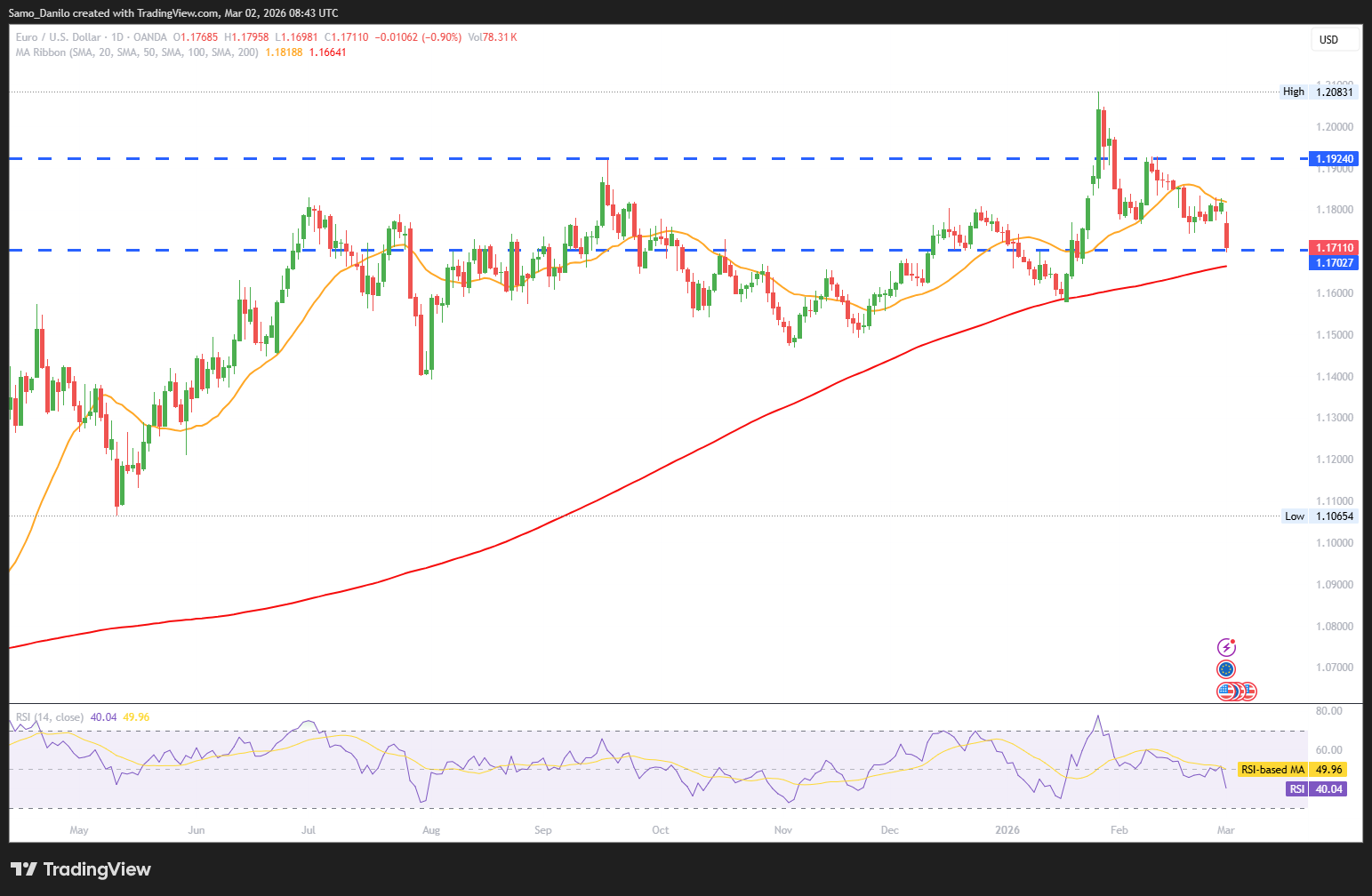
| SMA (20) | Slightly Falling |  |
|
| RSI (14) | Falling | | |
| MACD (12, 26, 9) | Slightly Falling | |
Closing statement: EUR/USD is under downward pressure driven by renewed global risk aversion and geopolitically-induced US Dollar strength, while energy price and trade dynamics further disadvantage the Euro; near-term direction will likely hinge on developments in the Middle East and the upcoming Eurozone inflation release.
GBPUSD
- GBP/USD Price: GBP/USD remains under heavy pressure, trading around 1.3360 during the European session on Monday. The pair reflects persistent US Dollar strength amid elevated geopolitical risk and a broader risk-averse environment.
- Middle East: Political instability in Iran has intensified following the death of its Supreme Leader, with a provisional council assuming control and expectations of continued retaliatory strikes in the near term. This backdrop supports safe-haven demand for the USD and weighs on risk-sensitive currencies like the Pound.
- Diplomatic signals: US President Donald Trump has indicated openness to engaging with Iran’s new leadership, while simultaneously warning the conflict could last several weeks. The lack of a clear diplomatic timeline and Iran’s rejection of negotiations keeps uncertainty elevated, favoring USD strength.
- Inflation concerns: On the UK front, Bank of England Chief Economist Huw Pill cautioned that UK inflation risks remain skewed to the upside, noting that disinflation has progressed more slowly than expected. These comments complicate expectations for near-term rate cuts and offer some underlying support to GBP.
- Economic data: Market participants are now turning attention to key US labor indicators, particularly the Nonfarm Payrolls report for February, alongside the ISM Manufacturing PMI. Strong US data could further reinforce the USD and extend pressure on GBP/USD.

| SMA (20) | Slightly Falling | |
|
| RSI (14) | Falling | | |
| MACD (12, 26, 9) | Falling | | |
Closing statement: GBP/USD remains vulnerable as geopolitical risk and US data dominance favor the Dollar, while cautious BoE messaging provides only limited support; near-term direction will hinge on US employment data and any easing, or escalation, of Middle East tensions.
XAUUSD
- XAU/USD Price: Gold (XAU/USD) surges to a fresh high since late January during the early European session on Monday, with prices pushing above the $5,400 handle. The move reflects strong safe-haven inflows as investors seek protection amid escalating global uncertainty.
- Middle East: The weekend saw a sharp deterioration in the security backdrop across the Middle East, with rising tensions involving the United States, Israel, and Iran. Reports of hundreds of explosions across the region, including Gulf states, have significantly increased geopolitical risk premiums, boosting demand for traditional safe havens like gold.
- Supply shock: Iran’s decision to halt oil shipments through the Strait of Hormuz has triggered a sharp spike in crude prices. Higher energy costs raise concerns about renewed inflationary pressures globally, reinforcing gold’s appeal as an inflation hedge and adding momentum to the ongoing rally.
- Inflation data: In the US, January Producer Price Index (PPI) data surprised to the upside, driven largely by the volatile trade services component rather than broad-based cost pressures. Despite this, US Treasury yields remain under pressure, suggesting markets view inflation risks as contained for now, an environment that continues to favor non-yielding assets like gold.
- Yield dynamics: US Treasury yields still appear to have room to decline before stabilizing, while German government bond yields are drifting toward key support levels. The synchronized softness in global yields lowers the opportunity cost of holding gold and underpins the metal’s bullish structure.
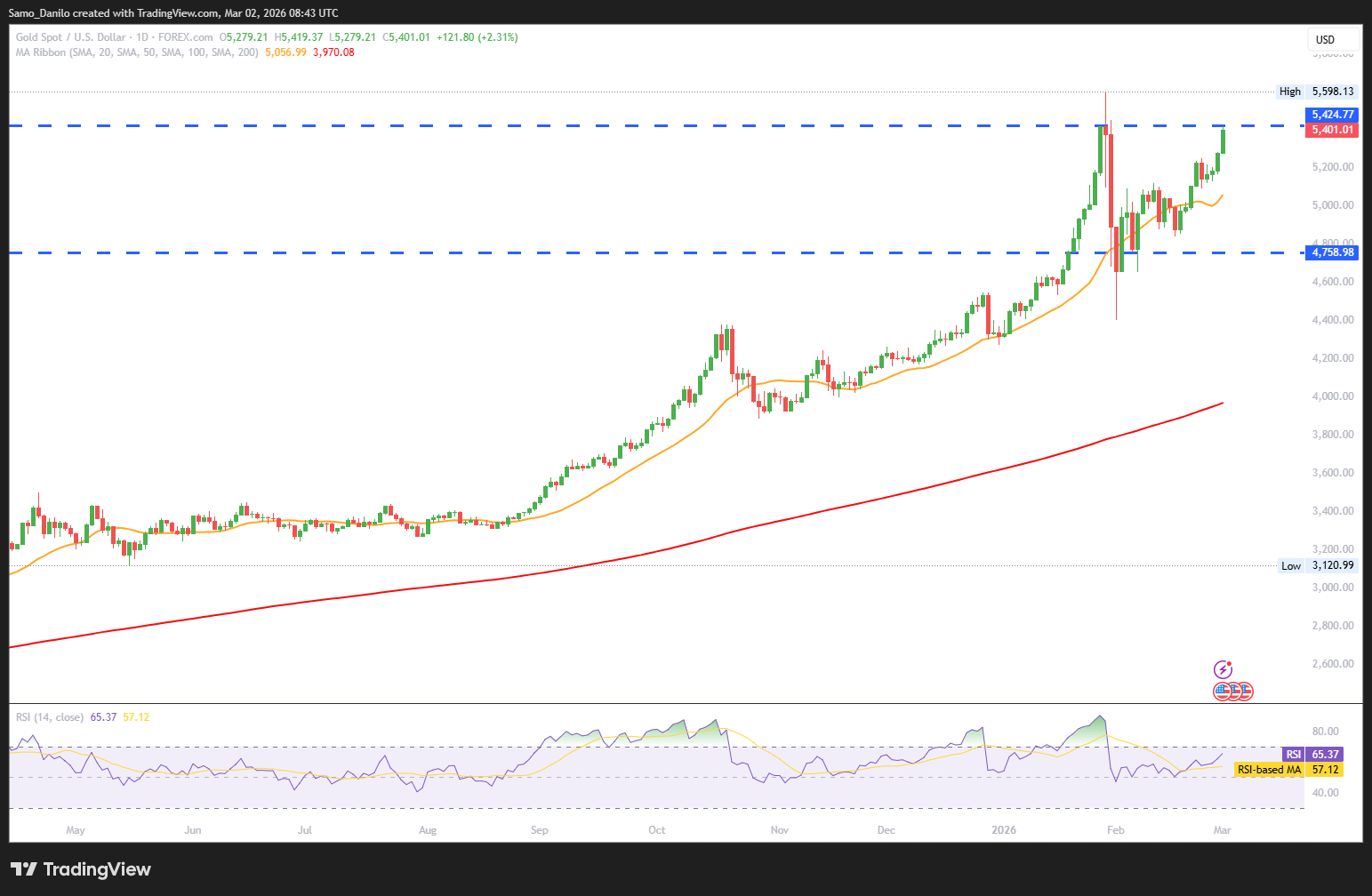
| SMA (20) | Rising |  | |
| RSI (14) | Rising | | |
| MACD (12, 26, 9) | Rising | | |
Closing statement: Gold remains firmly supported by a potent mix of geopolitical risk, rising oil-driven inflation concerns, and declining global bond yields. As long as safe-haven flows persist and yields stay subdued, XAU/USD appears well-positioned to extend gains beyond the $5,400 threshold.
CRUDE OIL
- Crude Oil Price: Crude oil markets opened the week with a pronounced bullish gap, with West Texas Intermediate (WTI) surging above $70 per barrel, marking its highest level since June. The aggressive move reflects an immediate market reaction to the closure of the Strait of Hormuz, a critical artery for global oil flows.
- Price shock: If the Strait of Hormuz remains blocked for an extended period, the global oil market could face a sustained supply shock comparable to the disruption seen after Russia’s invasion of Ukraine in February 2022. Given that roughly a fifth of global oil consumption transits through the strait, even partial disruptions have outsized price implications.
- OPEC+ supply: While OPEC+ has announced a production increase of 206,000 barrels per day (bpd) starting in April, this additional supply would be inadequate in the event of a complete, multi-week closure of the Strait of Hormuz. In such a scenario, spare capacity would struggle to offset lost barrels.
- Additional risks: Geopolitical risk is not confined to the Middle East. Reports indicate that Ukrainian drones struck an oil terminal at the Russian port of Novorossiysk, setting parts of the depot and port infrastructure on fire. These attacks add another layer of uncertainty to already fragile global energy supply chains.
- Price forecasts: Following the escalation in the Middle East, energy analysts and major investment banks expect oil prices to surge toward $90 per barrel, with a non-negligible chance of testing $100 if disruptions through the Strait of Hormuz persist. Goldman Sachs estimates an immediate $18 per barrel real-time geopolitical risk premium. However, if only around 50% of flows through the strait are halted for a month, Goldman suggests the war-related premium could moderate to roughly $4 per barr
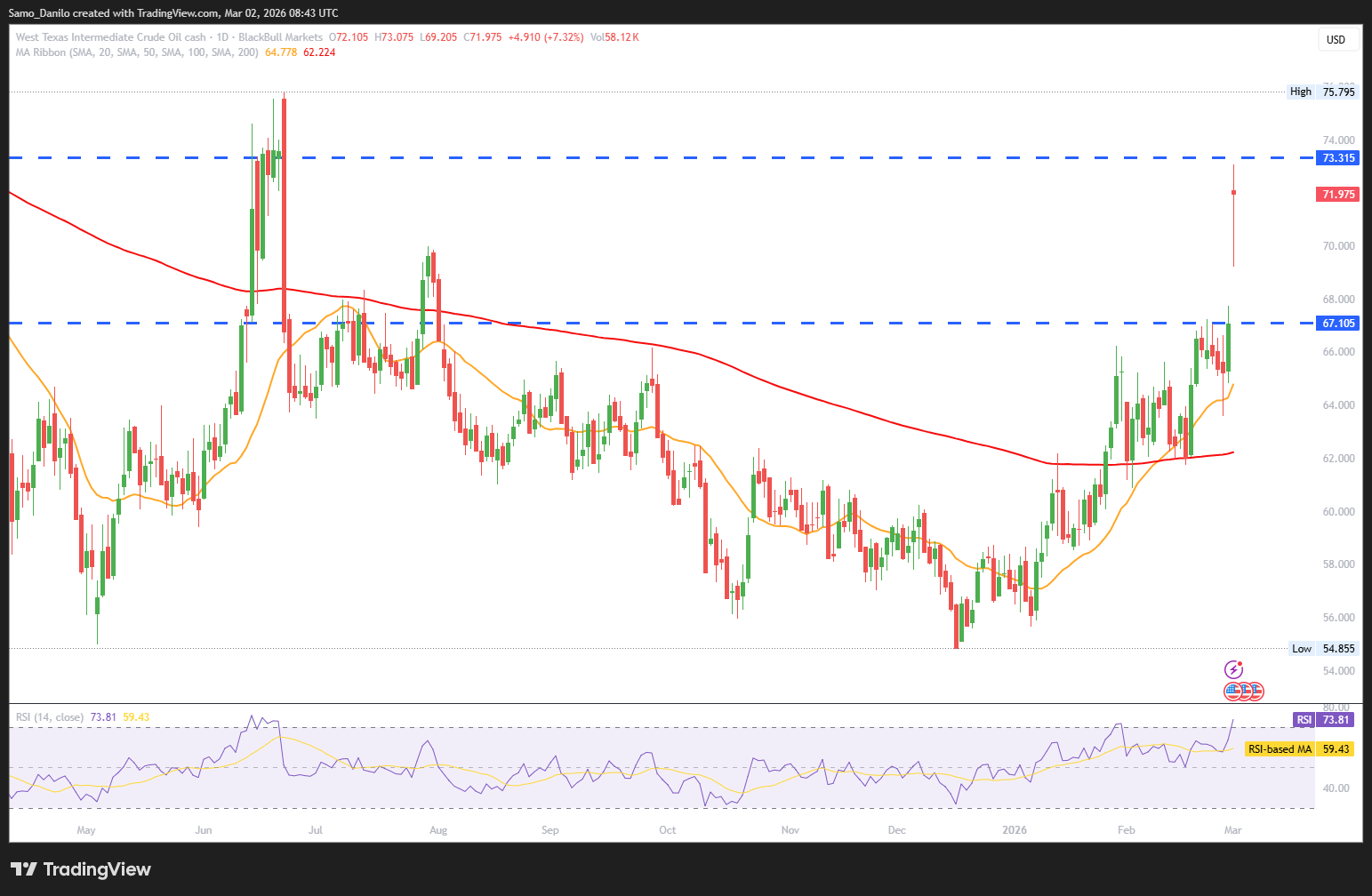
| SMA (20) | Rising | | |
| RSI (14) | Rising | | |
| MACD (12, 26, 9) | Rising | | |
Closing statement: Crude oil prices are being driven by an acute supply-side shock layered on top of already elevated geopolitical risks. As long as uncertainty around the Strait of Hormuz and broader regional stability persists, the balance of risks for oil prices remains decisively skewed to the upside.
DAX
- DAX Price: The DAX opened with a clear downside gap and is trading around 24,740 points, signaling a cautious tone at the start of the session. This price action suggests investors are reacting defensively to a combination of macroeconomic softness and elevated geopolitical uncertainty.
- Inflation data: German headline inflation eased to 2.0% year-over-year, slightly below expectations, driven mainly by sharply lower food inflation. However, core inflation held steady at 2.5%, while services inflation regained momentum after a temporary VAT-related dip, pointing to stable underlying price dynamics rather than a broad-based disinflation trend.
- Retail sales: German retail sales fell 0.9% month-on-month in January, significantly worse than the expected 0.2% decline. This underperformance raises concerns about household consumption in Germany, which could weigh on near-term growth expectations and equity sentiment.
- Geopolitical tensions: Geopolitical risk intensified after Iran’s top security official stated that Tehran would not negotiate with the United States, hardening its stance after recent speculation about a possible nuclear deal. This escalation adds to global risk aversion and pressures European equities via energy prices and broader uncertainty.
- Manufacturing PMI: Later in the session, investors will closely watch the final Eurozone manufacturing PMI for February, which is expected to confirm a move back into expansionary territory. A confirmation could offer some support to cyclical stocks, partially offsetting the negative macro and geopolitical backdrop.

| SMA (20) | Slightly Rising | |
| RSI (14) | Slightly Falling | |
| MACD (12, 26, 9) | Slightly Rising | |
Closing statement: The DAX remains under pressure as weaker domestic demand data and renewed geopolitical tensions overshadow easing headline inflation. While an improving manufacturing outlook could provide some stabilization, near-term risks suggest the index may struggle to regain upward momentum without a clear improvement in sentiment.