
EURUSD
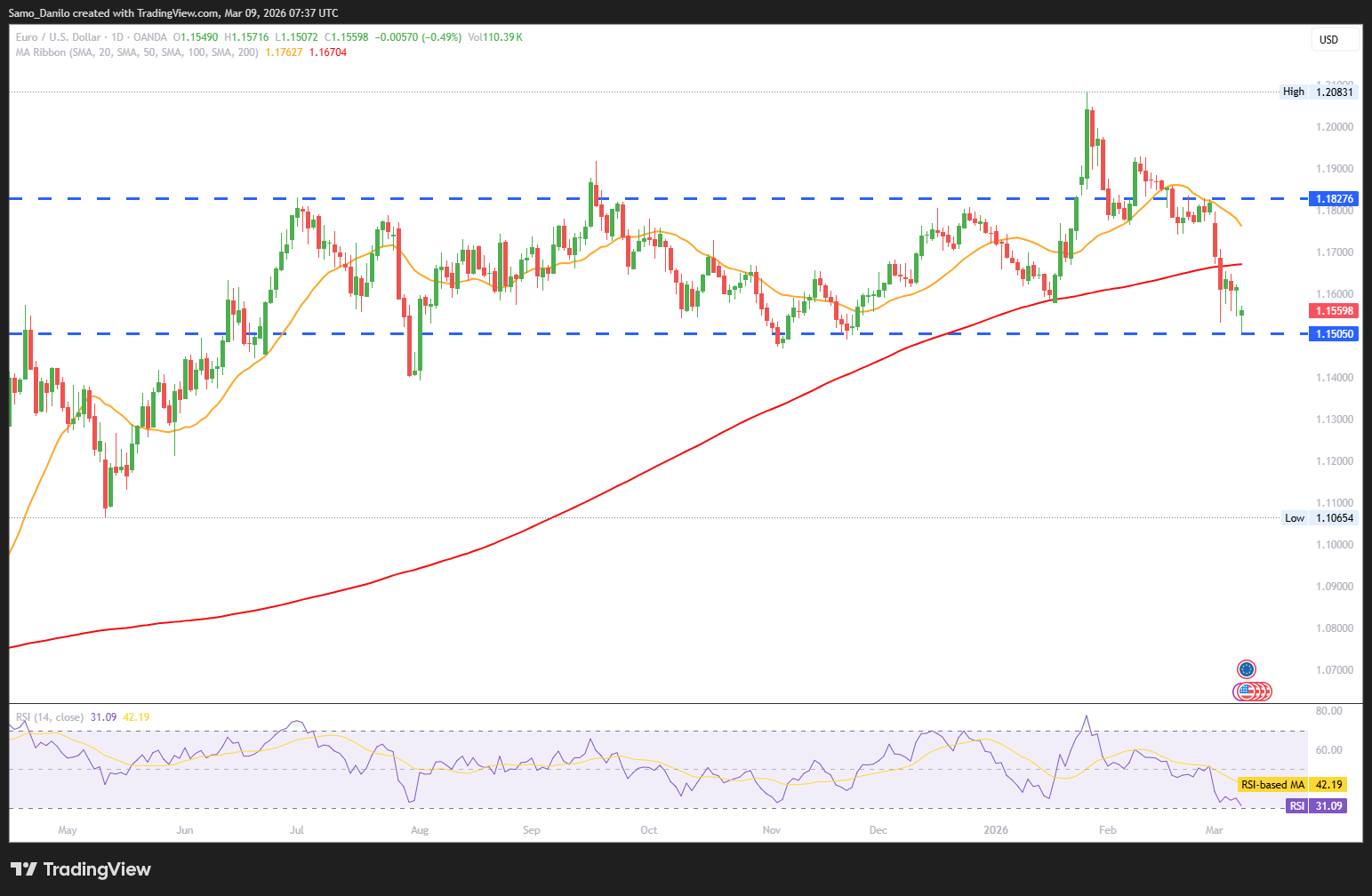
- EUR/USD Price: The EUR/USD pair is trading slightly higher around 1.1545 during European trading hours on Monday, extending modest gains from the previous session. Despite the upward movement, the pair remains sensitive to global risk sentiment and geopolitical developments.
- US Dollar: Investors are looking past the weaker-than-expected Nonfarm Payrolls report released on Friday. However, escalating tensions in the Middle East have renewed demand for the US Dollar, which traditionally benefits from safe-haven flows during periods of geopolitical uncertainty.
- Leadership change: The conflict involving Iran, Israel, and the United States has entered its tenth day. Mojtaba Khamenei has reportedly been named the new Supreme Leader following the death of Ali Khamenei during the initial wave of US–Israeli strikes, marking a significant political shift in Iran.
- Sentiment data: Markets are awaiting the release of Sentix Investor Confidence for March. The index is expected to show a notable decline as investor sentiment in the Eurozone weakens amid rising geopolitical uncertainty linked to the conflict in the Middle East.
- US inflation: Traders are now focused on the upcoming US Inflation release later this week for clues about the future interest rate path of the Federal Reserve. The data could play a crucial role in shaping expectations regarding the timing and scale of potential rate cuts.
| SMA (20) | Slightly Rising |  |
|
| RSI (14) | Falling |  | |
| MACD (12, 26, 9) | Falling | | |
Closing statement: EUR/USD remains caught between modest euro strength and renewed demand for the US dollar driven by geopolitical tensions. Upcoming Eurozone sentiment data and US inflation figures will likely provide the next major directional cues for the pair.
GBPUSD
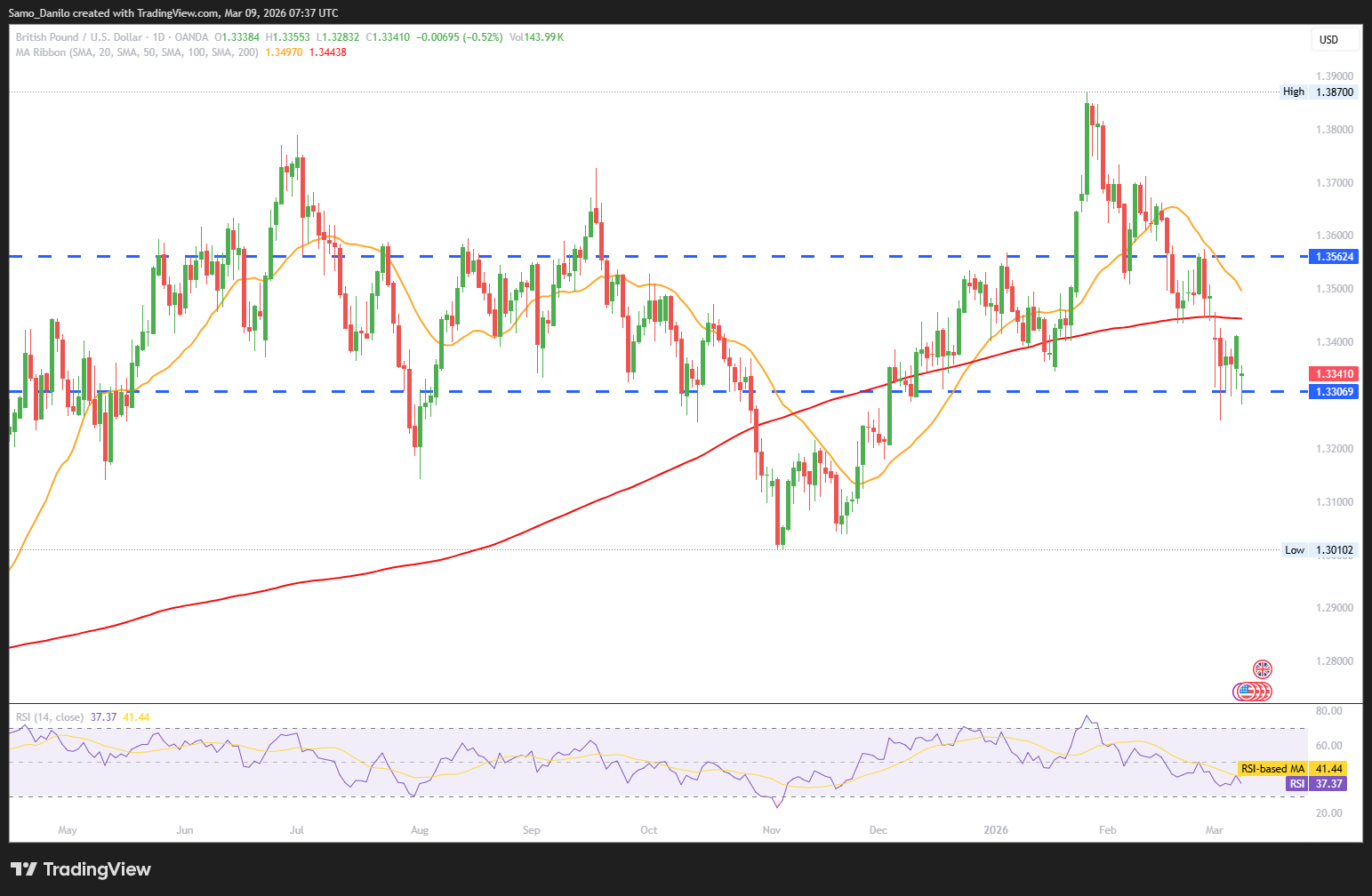
- GBP/USD Price: The GBP/USD pair is trading lower around 1.3310 during the early European session on Monday. The move reflects renewed demand for the US Dollar, driven primarily by heightened geopolitical uncertainty.
- US pressure: Donald Trump called for Iran’s “unconditional surrender” and indicated that the United States expects to play a role in selecting a future Iranian leader acceptable to Washington. Such statements have intensified geopolitical tensions and increased risk aversion in global markets, supporting the dollar.
- Energy prices: Rising energy costs are contributing to renewed inflationary pressures in the United Kingdom. As a result, markets are scaling back expectations for an imminent rate cut by the Bank of England, with futures markets currently indicating that policymakers may keep interest rates unchanged for the remainder of the year.
- UK Government: UK Prime Minister Keir Starmer reiterated that Britain will not participate in the initial US-Israeli strikes against Iran, stressing the importance of diplomatic solutions. The stance highlights a more cautious approach by the UK government amid escalating regional tensions.
- US-UK tensions: Over the weekend, Donald Trump dismissed reports that the UK intended to deploy the HMS Prince of Wales to the Middle East. He also criticized Britain as a “once great ally,” underscoring growing political friction between the two countries during the crisis.
| SMA (20) | Slightly Falling | |
|
| RSI (14) | Falling | | |
| MACD (12, 26, 9) | Falling | | |
Closing statement: GBP/USD remains under pressure as geopolitical tensions boost demand for the US dollar. While persistent inflation concerns in the UK may limit expectations for rate cuts by the Bank of England, global risk sentiment and developments in the Middle East are likely to remain the primary drivers of the pair in the near term.
XAUUSD
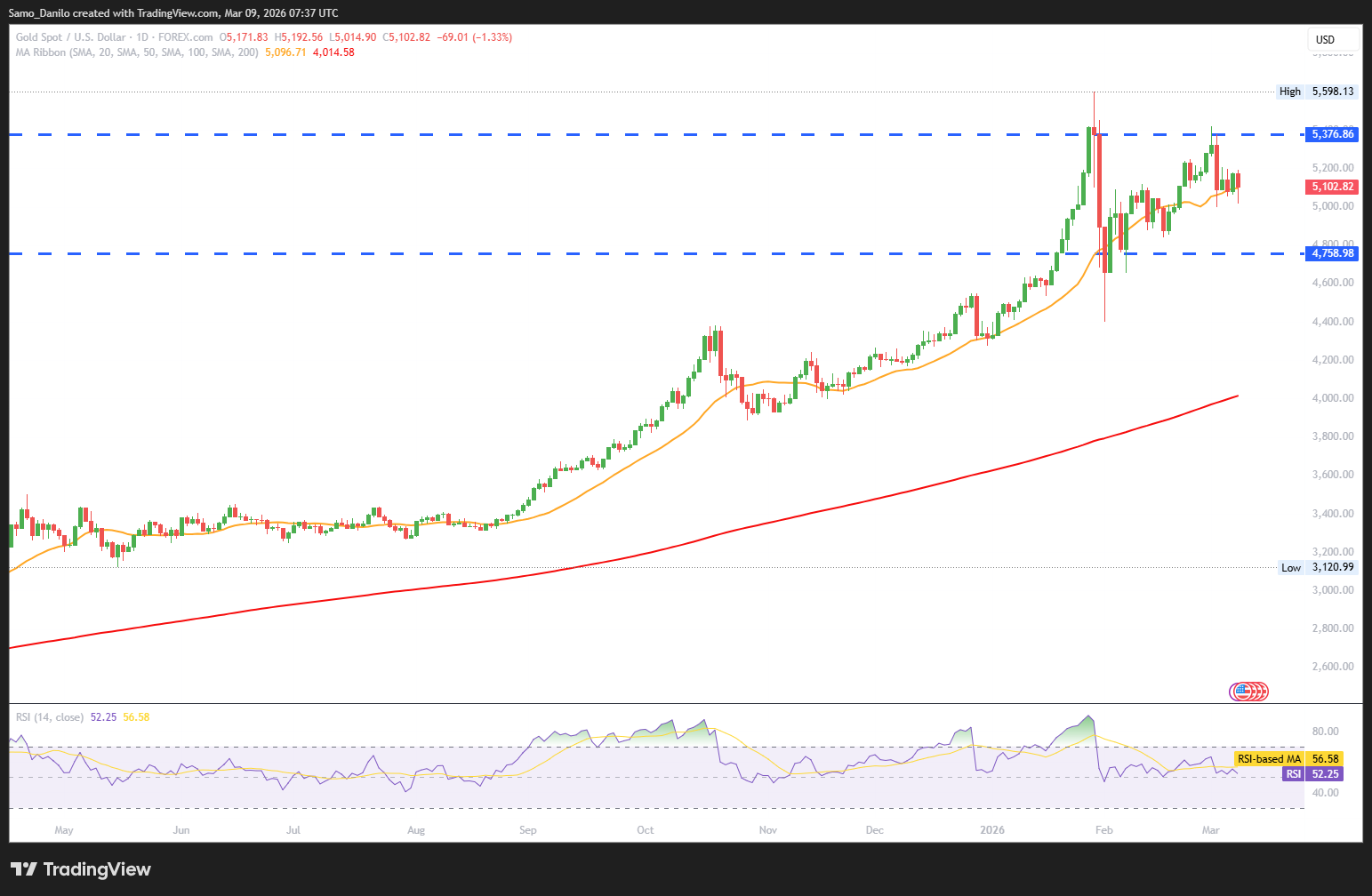
- XAU/USD Price: The XAU/USD pair has recovered slightly from its session lows but remains under pressure at the start of the week, trading around $5,100. Strong gains in Crude Oil prices amid escalating Middle East tensions are dominating market sentiment and influencing broader commodity markets.
- Labor market: The latest Nonfarm Payrolls report showed a significant deterioration in US labor market conditions, with payrolls falling by 92,000 in February. Meanwhile, the US Unemployment Rate rose to 4.4% from 4.3% in January, highlighting potential cooling in economic momentum.
- Latin America: Donald Trump hosted a summit in Florida with leaders from Argentina, Chile, Ecuador, and other nations to establish a coalition aimed at combating drug cartels. The initiative includes potential US military support for regional partners, signaling a broader security push in Latin America.
- China’s data: Markets are closely watching upcoming trade data from China, covering January and February combined. Export figures will be particularly important, as expectations remain for strong growth supported by competitive manufacturing and resilient global industrial demand.
- Hormuz disruption: Energy markets remain volatile as the United Arab Emirates and Kuwait have started reducing oil production following disruptions linked to the closure of the Strait of Hormuz. Supply constraints in this key global shipping route are intensifying pressure on energy markets and influencing broader commodity sentiment.
| SMA (20) | Rising | | |
| RSI (14) | Slightly Rising | |
|
| MACD (12, 26, 9) | Slightly Rising | |
Closing statement: Gold remains relatively heavy despite safe-haven demand, as surging oil prices and geopolitical tensions dominate market dynamics. Investors will closely monitor global trade data and developments in the Middle East for further direction in precious metals markets.
CRUDE OIL
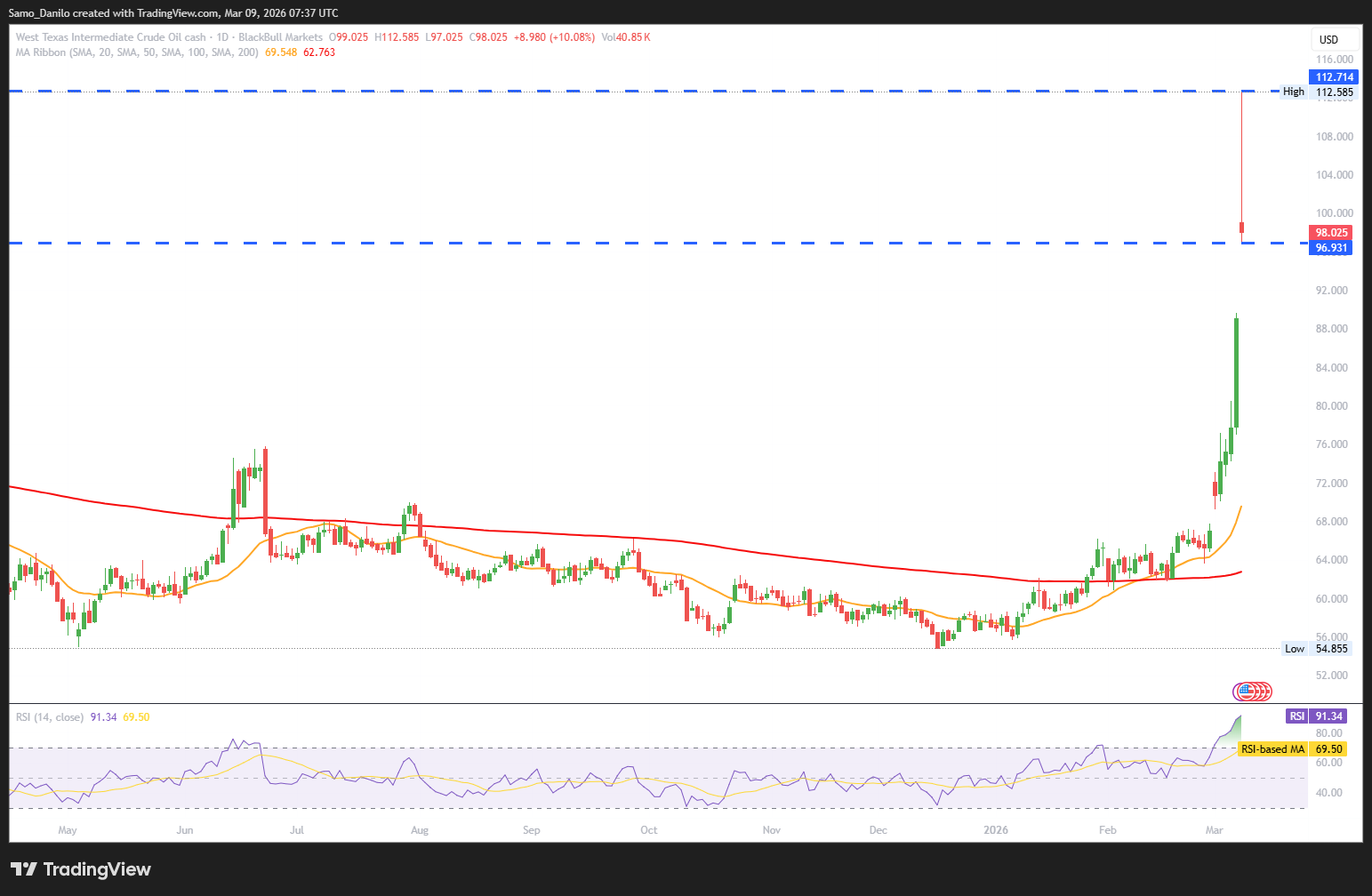
- Crude Oil Price: The Crude Oil market experienced extreme volatility, briefly surging above the key $100 psychological level and reaching highs near $117 before retreating below $100. Prices have climbed more than 25% since the start of the Middle East conflict, reflecting growing fears of significant supply disruptions.
- Hormuz disruptions: Supply concerns intensified as oil producers began shutting down operations following the halt of tanker traffic through the Strait of Hormuz. The situation worsened after a large oil storage facility in Iran was reportedly struck, raising fears of further damage to critical energy infrastructure.
- Gulf conflict: Military tensions have escalated as Iran launched missiles and drones targeting Israel and several Gulf nations, including Saudi Arabia, United Arab Emirates, Kuwait, and Bahrain. The widening conflict has significantly increased the risk premium in energy markets.
- Oil reserves: The International Energy Agency is reportedly discussing a coordinated release of strategic petroleum reserves among member states. Such emergency measures are typically used to stabilize markets during severe supply disruptions and could help ease upward pressure on prices.
- Spot market: In an unusual move, Saudi Arabia has begun offering crude on the spot market due to the near-complete freeze in tanker traffic through the Strait of Hormuz. Approximately 4.6 million barrels of Arab Light, Arab Extra Light, and Arab Heavy have reportedly been offered to buyers to help maintain supply flows.
| SMA (20) | Rising | | |
| RSI (14) | Rising | | |
| MACD (12, 26, 9) | Rising | | |
Closing statement: Crude oil markets remain highly volatile as geopolitical tensions threaten one of the world’s most important energy supply routes. Emergency measures by the IEA and supply adjustments from Saudi Arabia may help stabilize prices, but the trajectory of the conflict will remain the dominant driver for oil markets in the near term.
DAX
- DAX Price: The DAX faced strong selling pressure as European markets reopened after the weekend, briefly falling below the 23,000-point level, its lowest level since November 2025, before recovering somewhat. The sharp move reflects investor concerns about geopolitical risks and weakening economic indicators in Europe.
- Election results: Sunday’s regional election in Baden-Württemberg delivered a narrow victory for Alliance 90/The Greens, which secured 30.2% of the vote. The Christian Democratic Union, led nationally by Friedrich Merz, followed closely with 29.7%, while the Alternative for Germany finished third with 18.8%, reinforcing its position as the country’s main opposition force.
- Industrial production: Data from Destatis showed that Germany’s January industrial production declined by 0.5% month-over-month, missing expectations for a 1.0% increase. The weak reading signals continued fragility in Germany’s manufacturing sector despite an upward revision to December’s data.
- Factory orders: German industrial orders fell by 11.1% month-over-month in January, significantly worse than the expected 4.5% decline. However, excluding large-scale orders, factory demand decreased by only 0.4%, suggesting that the headline figure may exaggerate the underlying weakness in industrial activity.
- Eurozone growth: The third estimate for fourth-quarter GDP in the Eurozone confirmed slower economic growth, with output expanding by 0.2% quarter-on-quarter. This was lower than the earlier estimate of 0.3% and below the 0.3% growth rate recorded in the previous quarter, highlighting weakening economic momentum across the region.
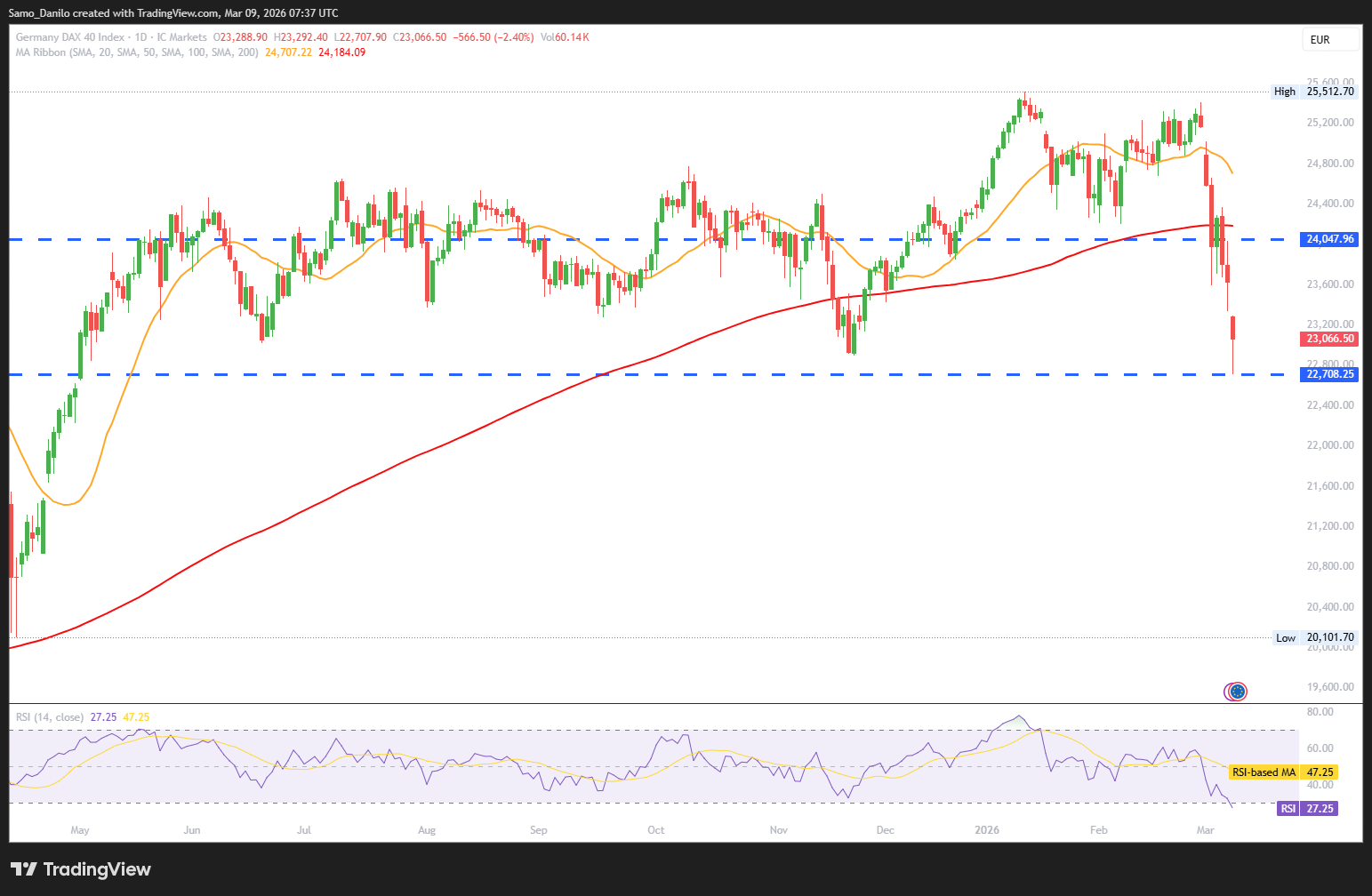
| SMA (20) | Slightly Falling | |
|
| RSI (14) | Falling | | |
| MACD (12, 26, 9) | Falling | | |
Closing statement: The DAX remains under pressure as investors weigh political developments in Germany alongside weak industrial data and slowing Eurozone growth. Market sentiment is likely to remain fragile in the near term as economic indicators continue to signal a softening outlook for Europe’s largest economy.