
EURUSD
- EUR/USD Price: The EUR/USD moved higher toward the 1.1645 level during the early European session. The pair’s gains reflect a mix of improving Eurozone sentiment data and shifting expectations around monetary policy in the European Central Bank.
- Middle East: The Islamic Revolutionary Guard Corps warned that Iran could disrupt regional oil exports if military actions by United States and Israel continue. Such a move could significantly tighten global energy supplies and increase volatility in financial markets.
- Stagflation risks: As the Eurozone is a major net importer of energy, rising Crude Oil prices could push inflation higher while simultaneously slowing economic growth. This combination raises concerns about potential stagflation, which could complicate monetary policy decisions in the region.
- Investor confidence: March investor sentiment in the Eurozone, measured by the Sentix Investor Confidence Index, came in at -3.1, outperforming expectations of -5.0. Although still in negative territory, the reading suggests that investor confidence held up slightly better than feared despite geopolitical tensions.
- ECB Rate: According to Reuters, financial markets are now pricing in up to two 25-basis-point interest rate increases from the European Central Bank this year. This marks a notable shift from earlier expectations that interest rates would remain unchanged through 2026.
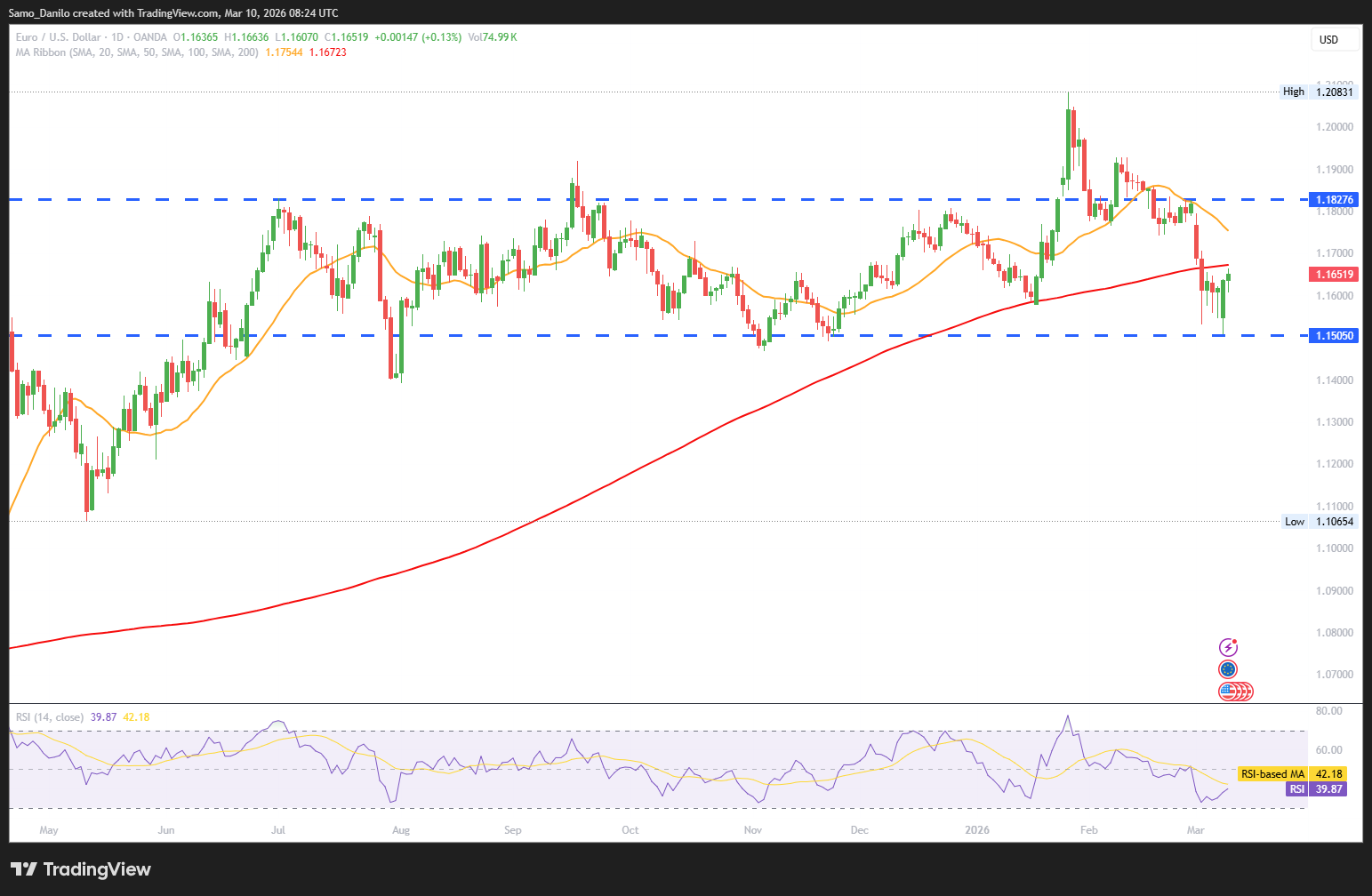
| SMA (20) | Slightly Rising |  |
|
| RSI (14) | Falling |  | |
| MACD (12, 26, 9) | Falling | | |
Closing statement: EUR/USD is supported by improved investor sentiment and shifting expectations for tighter ECB policy. However, escalating geopolitical tensions and rising energy prices remain key risks that could influence both inflation dynamics and economic growth across the Eurozone.
GBPUSD
- GBP/USD Price: The GBP/USD struggled to extend the previous session’s gains but still moved slightly higher toward the 1.3460 level during European trading. The pair’s modest advance reflects a balance between geopolitical uncertainty supporting the US Dollar and stronger interest rate expectations supporting the Pound.
- Hormuz disruption: Donald Trump warned that Iran would face military retaliation if it attempted to block oil flows through the Strait of Hormuz. Such threats highlight the geopolitical tensions affecting global markets and contributing to safe-haven demand for the US Dollar.
- Rate expectations: The Pound Sterling has been supported by a sharp repricing of monetary policy expectations. Markets have moved from anticipating three interest rate cuts to pricing in roughly a 70% probability that the Bank of England could deliver a rate hike by the end of the year.
- BoE Governor: Investors are closely watching comments from Andrew Bailey, Governor of the Bank of England, scheduled for Thursday. His remarks may provide additional insight into the central bank’s policy outlook and could influence short-term movements in the Pound.
- Data ahead: Later this week, attention will shift to the release of the United Kingdom’s January Gross Domestic Product, expected to rise by 0.2% month-on-month, alongside Manufacturing Production data also forecast at 0.2%. These indicators will be crucial in assessing the strength of the UK economy.
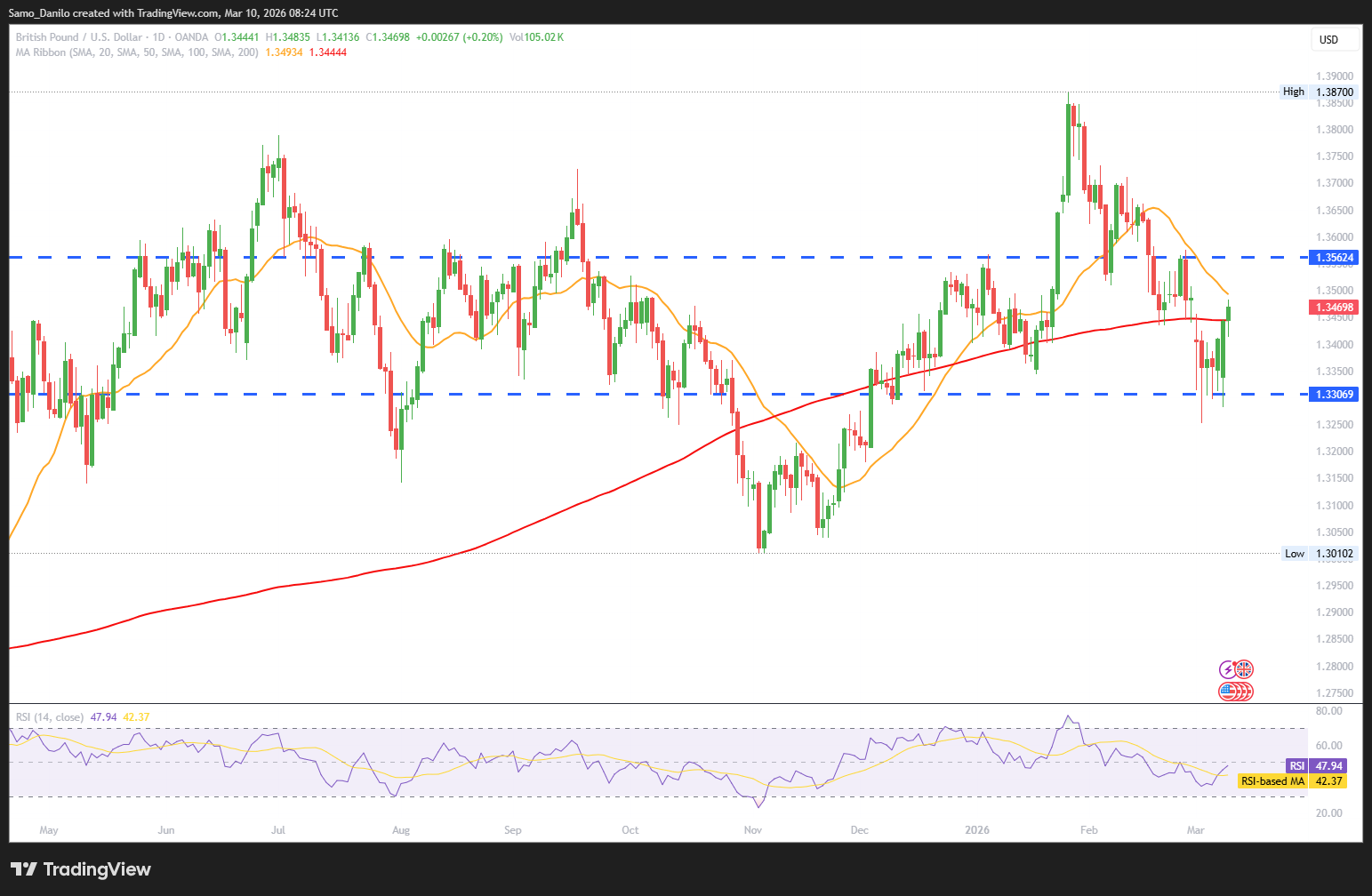
| SMA (20) | Falling | | |
| RSI (14) | Slightly Rising | |
|
| MACD (12, 26, 9) | Falling | | |
Closing statement: GBP/USD remains supported by stronger expectations for tighter Bank of England policy, but geopolitical tensions and upcoming economic data could drive further volatility. Markets will closely watch central bank signals and economic releases for confirmation of the UK’s monetary policy trajectory.
XAUUSD
- XAU/USD Price: The XAU/USD continues to trade with mild intraday gains heading into the European session, though buying momentum remains limited. Despite safe-haven demand, the Gold price is still struggling to break above the key $5,200 psychological level.
- Middle East: Officials in Iran dismissed comments from Donald Trump suggesting the Middle East conflict could end soon, warning that regional security must apply to all countries equally. The ongoing tensions across the region continue to underpin demand for traditional safe-haven assets such as gold.
- Chinese data: Trade data from China showed exports jumping 21.8% year-over-year in January–February, significantly above the 7.1% market expectation. The surge was largely driven by robust demand for electronics, alongside strong performance in clothing, textiles, and bag exports.
- Anthropic news: The artificial intelligence company Anthropic has filed lawsuits against the United States Government, contesting its designation as a supply-chain risk and the blacklisting of its AI model Claude for military applications. The dispute reportedly stems from the company’s refusal to remove safeguards preventing the technology from being used for autonomous weapons or domestic surveillance.
- US data: Investors are now focused on the upcoming release of the NFIB Small Business Optimism Index for February. The indicator has shown gradual improvement over the winter months, and the latest reading could provide fresh insight into the health of the US small business sector.
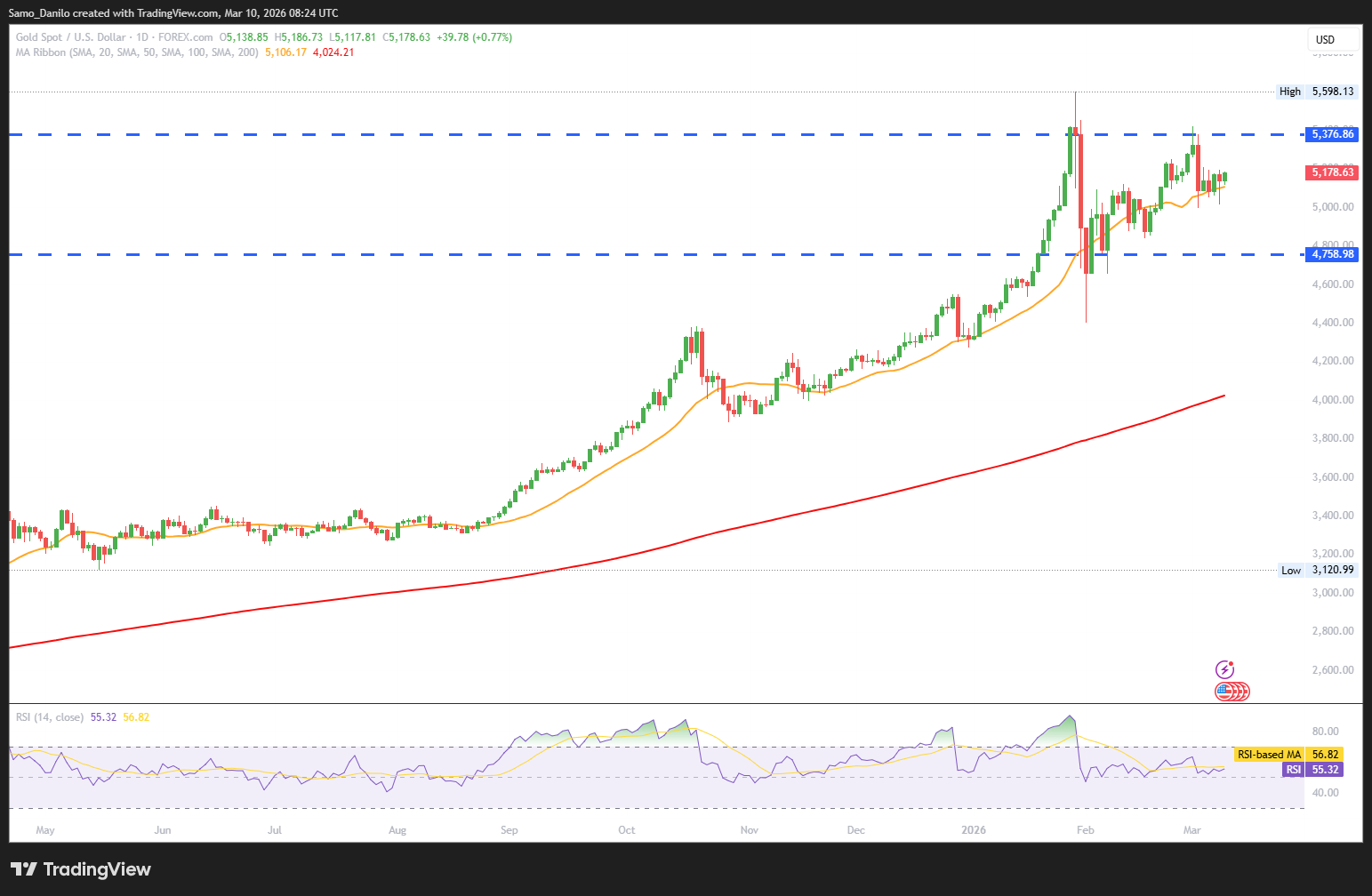
| SMA (20) | Rising | | |
| RSI (14) | Slightly Rising | |
|
| MACD (12, 26, 9) | Slightly Rising | |
Closing statement: Gold remains supported by geopolitical tensions and safe-haven demand but lacks strong upside momentum. Upcoming US economic data and developments in global risk sentiment will likely determine whether gold can regain bullish momentum above the $5,200 level.
CRUDE OIL
- Crude Oil Price: The Crude Oil market experienced extreme volatility after US crude surged to around $120 per barrel due to escalating tensions in the Middle East. However, prices retraced sharply during Monday’s session, ending more than 7% lower near the $85 level as market fears partially eased.
- G7 reserve: The G7 signaled the possibility of releasing strategic petroleum reserves to stabilize energy markets. This potential supply injection helped cool the rally in crude prices by reassuring markets that emergency barrels could be deployed if disruptions worsen.
- US signals: Donald Trump announced plans to temporarily waive oil-related sanctions and deploy the United States Navy to escort tankers through the Strait of Hormuz. These measures aim to ensure the continued flow of energy supplies while the conflict with Iran unfolds.
- Saudi Aramco: Amin H. Nasser, President and CEO of Saudi Aramco, acknowledged the heightened geopolitical risks in the region. Despite the uncertainty, he emphasized that the company is working to meet the majority of customer demand under current market conditions.
- Sanctioned crude: According to Kpler data cited by Bloomberg, nearly 40 million barrels of sanctioned crude from Iran, Russia, and Venezuela are currently stored on tankers near China. These idle volumes represent potential supply that could return to the market if sanctions or logistical constraints change.
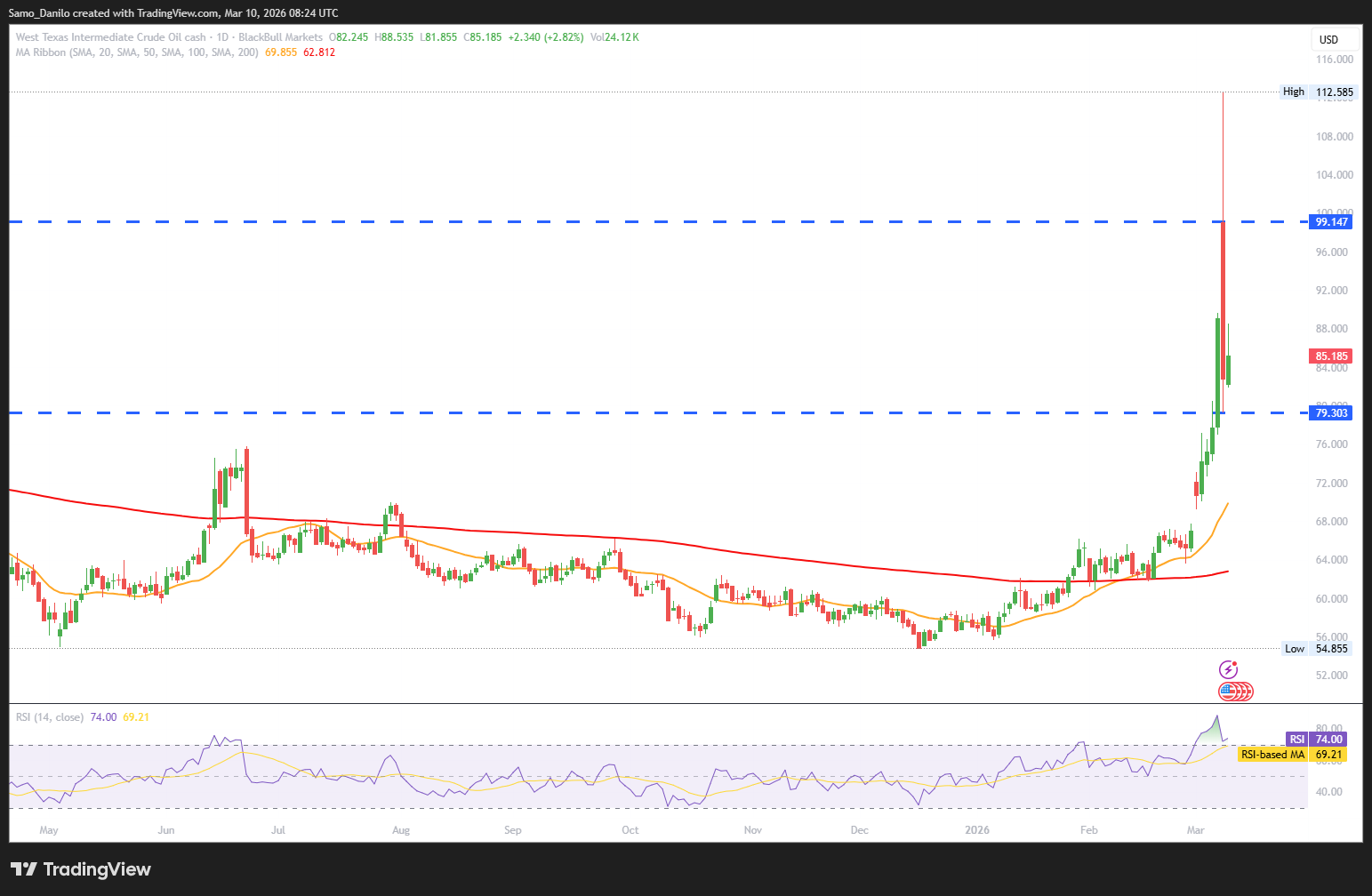
| SMA (20) | Rising | | |
| RSI (14) | Rising | | |
| MACD (12, 26, 9) | Rising | | |
Closing statement: Crude oil markets remain highly volatile as geopolitical tensions clash with potential supply interventions from major economies. While strategic reserve releases and tanker escorts may stabilize prices in the short term, ongoing conflict risks will continue to shape the oil market outlook.
DAX
- DAX Price: The DAX initially fell sharply to 22,927 points on Monday morning following escalating geopolitical tensions and rising energy prices over the weekend. However, the market quickly stabilized as investors stepped in to buy the dip, allowing the index to recover toward the 23,800 level.
- Trade surplus: Data from Destatis showed that Germany’s trade surplus increased to €21.2 billion in January, up from €17.4 billion in December 2025. The stronger surplus suggests resilient export performance despite ongoing economic uncertainty.
- Gas prices: The benchmark TTF Gas price has surged to around €60/MWh, marking its highest level since January 2023. Although far below the extreme peak of €346/MWh during the Russia-Ukraine conflict, the increase still raises concerns about renewed energy cost pressures for European industries and households.
- Volkswagen news: Volkswagen, Europe’s largest automaker, reported a significant decline in operating profit, which dropped to €8.9 billion. The decline reflects costs linked to strategic changes at its subsidiary Porsche as well as tariffs introduced by Donald Trump.
- Mercedes-Benz fined: The Korea Fair Trade Commission imposed a fine of 11.2 billion won (about $7.6 million) on Mercedes-Benz. The penalty was issued for allegedly misleading consumers regarding the battery suppliers used in certain electric vehicle models.

| SMA (20) | Slightly Rising | |
|
| RSI (14) | Falling | | |
| MACD (12, 26, 9) | Falling | | |
Closing statement: The DAX has shown resilience after an initial geopolitical shock, supported by bargain hunting among investors. Nevertheless, rising energy prices, corporate earnings pressures, and regulatory developments remain key factors influencing sentiment toward German equities.