
EURUSD
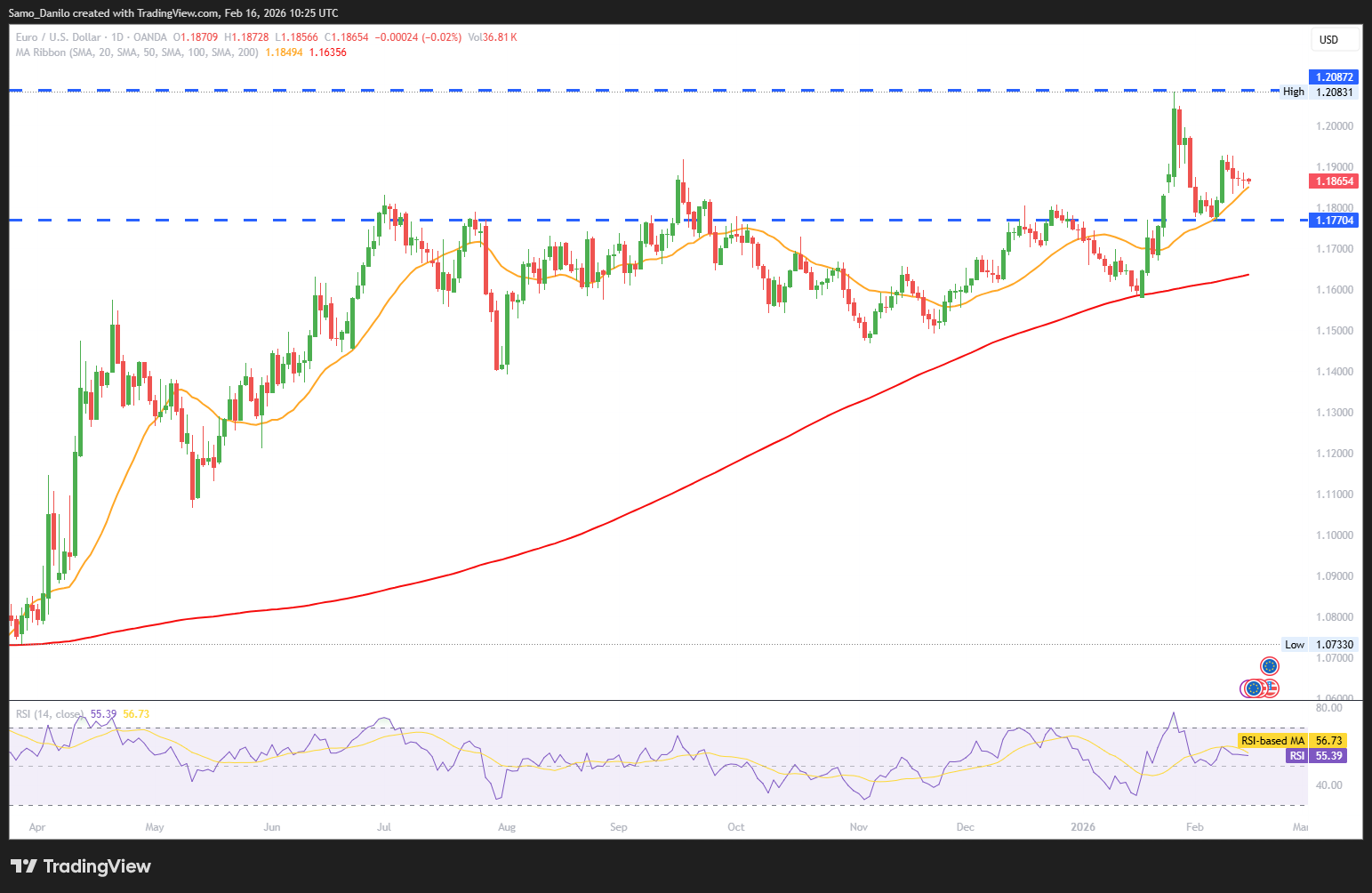
- EUR/USD Price: The EUR/USD pair inches down during European trading hours on Monday, hovering around 1.1860, with subdued liquidity weighing on price action.
- Labor market: Employment in the euro area rose 0.2% q/q in Q4 2025, matching Q3 and reinforcing the view that the labor market remains a hawkish constraint for the European Central Bank. Persistent labor strength limits the scope for near-term policy easing.
- Munich Conference: The Munich Security Conference concluded over the weekend amid elevated US–Europe tensions. US Secretary of State Marco Rubio reaffirmed Washington’s commitment to transatlantic ties, offering some reassurance, while reiterating calls for Europe to shoulder a greater share of its own security burden.
- US inflation: US January CPI broadly met expectations, with headline inflation easing to 2.4% y/y (from 2.7%) and core CPI slowing to 2.5% y/y, reinforcing expectations of gradual disinflation without materially shifting Fed policy expectations.
- Markets closed: The week starts on a muted note, with US markets closed for a holiday and China observing the Lunar New Year, keeping trading volumes thin and limiting directional conviction.
| SMA (20) | Rising |  | |
| RSI (14) | Slightly Rising | |
|
| MACD (12, 26, 9) | Slightly Rising | |
Closing statement: EUR/USD remains slightly pressured but range-bound, as firm Eurozone labor data offsets softer risk sentiment and modest USD resilience. With limited catalysts early in the week, the pair may continue to consolidate near mid-1.18 levels, awaiting clearer signals from upcoming central bank communication and fresh US data.
GBPUSD
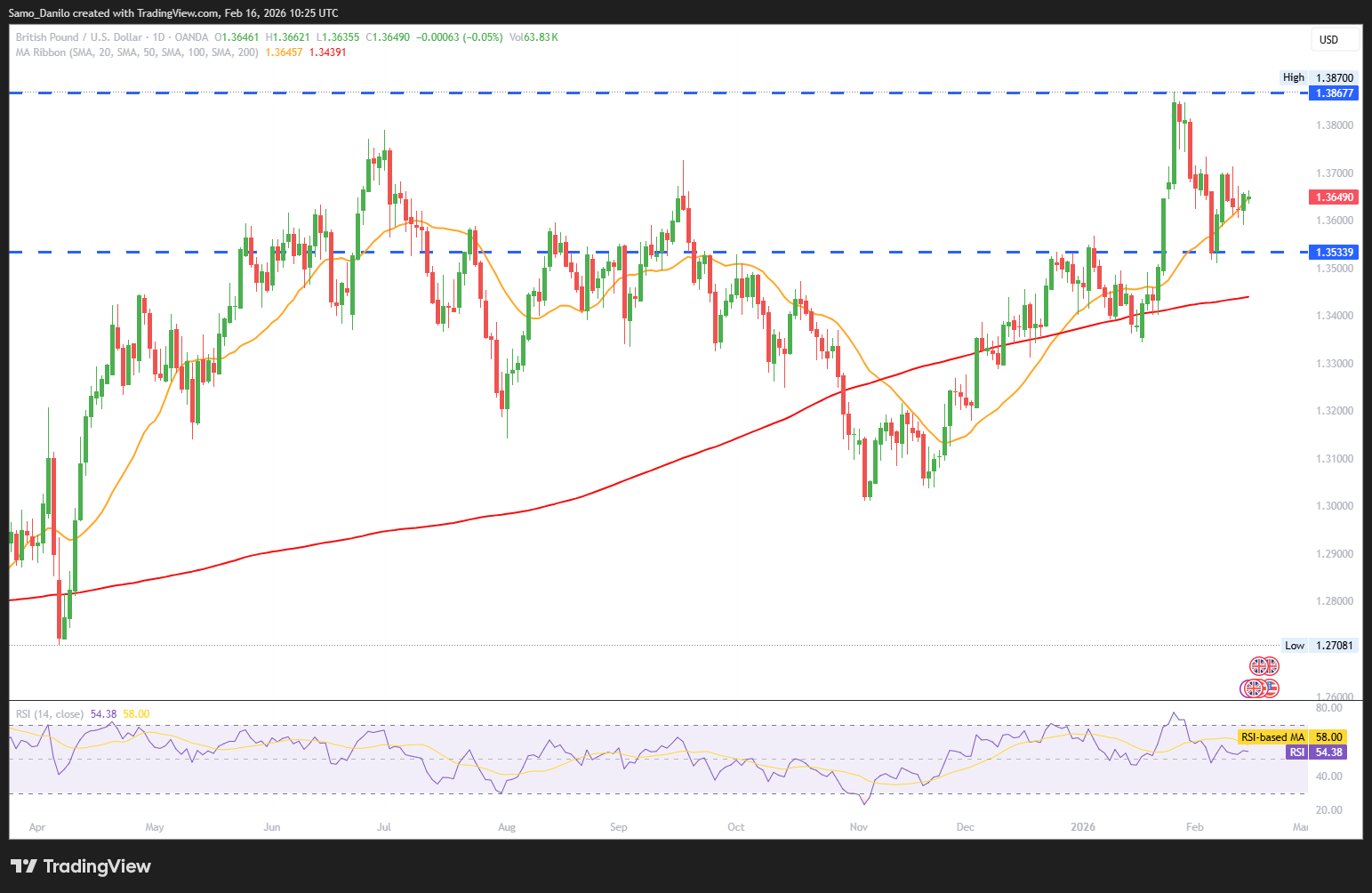
- GBP/USD Price: GBP/USD opens the new week on a subdued footing, oscillating in a tight range around 1.3650 during Monday’s European session as traders await fresh domestic cues.
- BoE policy: At its meeting earlier this month, the Bank of England held interest rates unchanged at 3.75% in a narrow 5-4 split, reiterating that policy is likely to follow a “gradual downward path”, reinforcing expectations of slow and data-dependent easing.
- Political situation: UK Prime Minister Keir Starmer received backing from his cabinet and Labour MPs following turbulence linked to the Jeffrey Epstein files, which resulted in the resignation of chief of staff Morgan McSweeney. The show of support helps limit immediate political downside risks for Sterling.
- Defense spending: According to the BBC, the UK government is considering accelerating plans to raise defense spending to 3% of GDP, only a year after lifting its target to 2.5% by 2027. The move reflects rising geopolitical pressures but could also add to medium-term fiscal concerns.
- Labor market: Markets await the UK employment report, with the ILO Unemployment Rate expected to hold steady at 5.1%. Average Earnings Including Bonuses, a key inflation signal for the BoE, are forecast to grow 4.6% y/y, suggesting wage pressures remain elevated but are easing gradually.
| SMA (20) | Rising | | |
| RSI (14) | Slightly Rising | |
|
| MACD (12, 26, 9) | Slightly Rising | |
Closing statement: GBP/USD remains directionless near mid-1.36 levels, caught between cautious BoE guidance and lingering political and fiscal uncertainty. A broadly stable labor market could help the Pound hold ground, but upside momentum may stay limited unless wage growth surprises meaningfully or global USD sentiment weakens.
XAUUSD
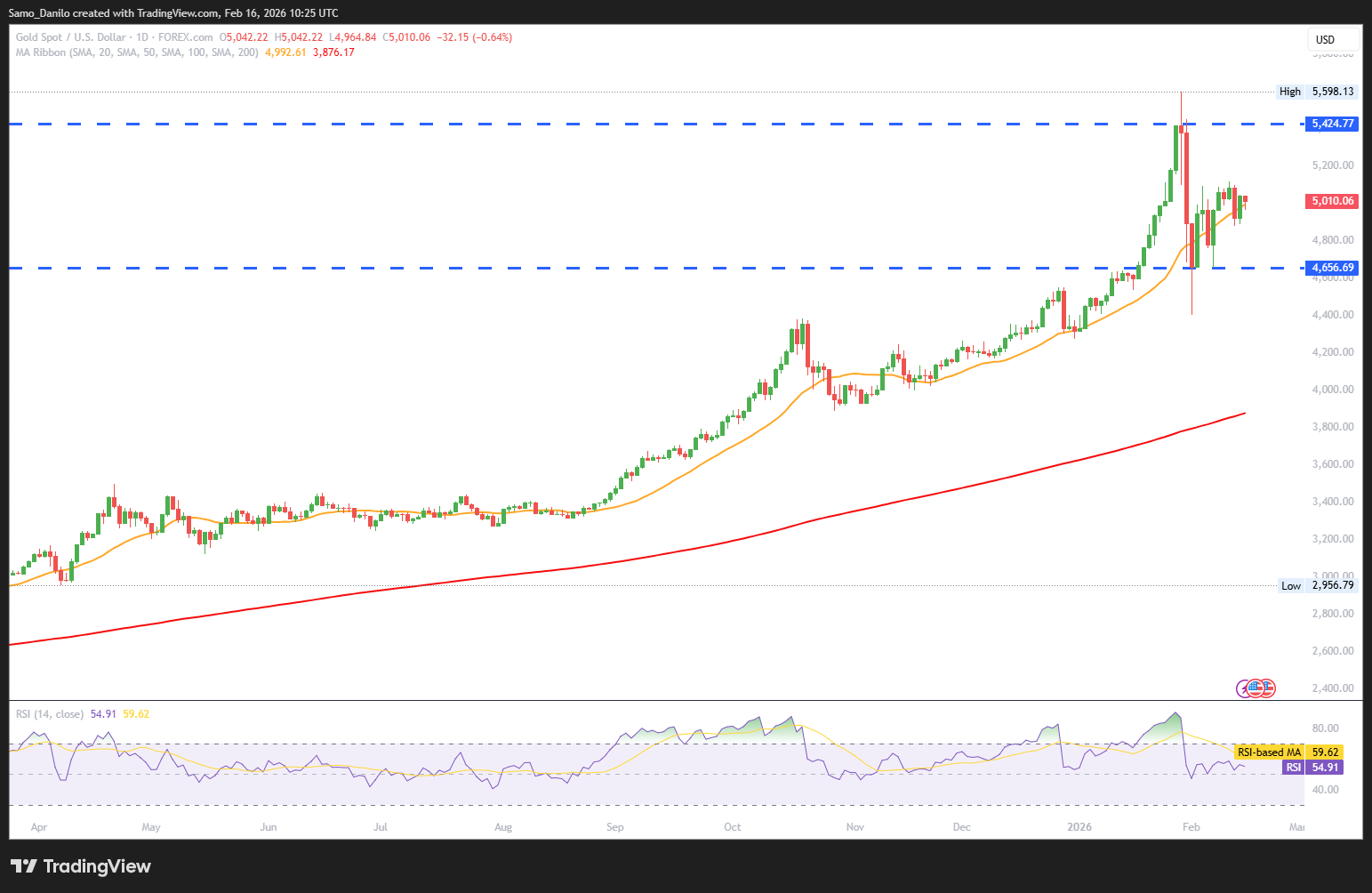
- XAU/USD Price: Gold prices attract fresh selling pressure at the start of the new week, paring a portion of Friday’s sharp rally of more than $150 from sub-$4,900 levels as profit-taking sets in and the US Dollar firms modestly.
- Technical structure: From a chart perspective, gold continues to display a series of ascending triangle formations, April–August 2024, April–August 2025, and October–December 2025. Each of these breakouts previously triggered powerful $900–$1,000 directional moves, suggesting that the broader upside bias remains intact despite near-term consolidation.
- Geopolitical risk: Geopolitical tensions remain elevated ahead of the second round of US-Iran nuclear talks this week. The US has reportedly dispatched a second aircraft carrier to the region and is preparing contingency plans for a prolonged military campaign should negotiations fail, a backdrop that continues to provide underlying support for safe-haven gold demand.
- Ukraine-EU: At the security conference and ahead of peace talks involving Ukraine, Russia and the US, Ukrainian President Volodymyr Zelenskyy called for a clear timeline for Ukraine’s EU membership and requested long-term US security guarantees. European Union leaders declined to commit to a membership date, keeping political uncertainty elevated and supportive of defensive assets like gold.
- US jobs data: A better-than-expected US employment report, highlighting tight labour market conditions, gives the Federal Reserve sufficient justification to delay rate cuts into the first half of 2026. Policymakers are likely to seek further confirmation that disinflation is firmly established, which may limit gold’s upside in the short term via higher real yields.
| SMA (20) | Rising | | |
| RSI (14) | Slightly Rising | |
|
| MACD (12, 26, 9) | Slightly Rising | |
Closing statement: While gold is undergoing a healthy pullback after an outsized rally, the medium- to long-term bullish structure remains intact, supported by geopolitical risks and a strong technical backdrop. Near-term consolidation cannot be ruled out as Fed rate-cut expectations are pushed back, but any deeper dips may continue to attract buyers, keeping gold well bid on a broader horizon.
CRUDE OIL
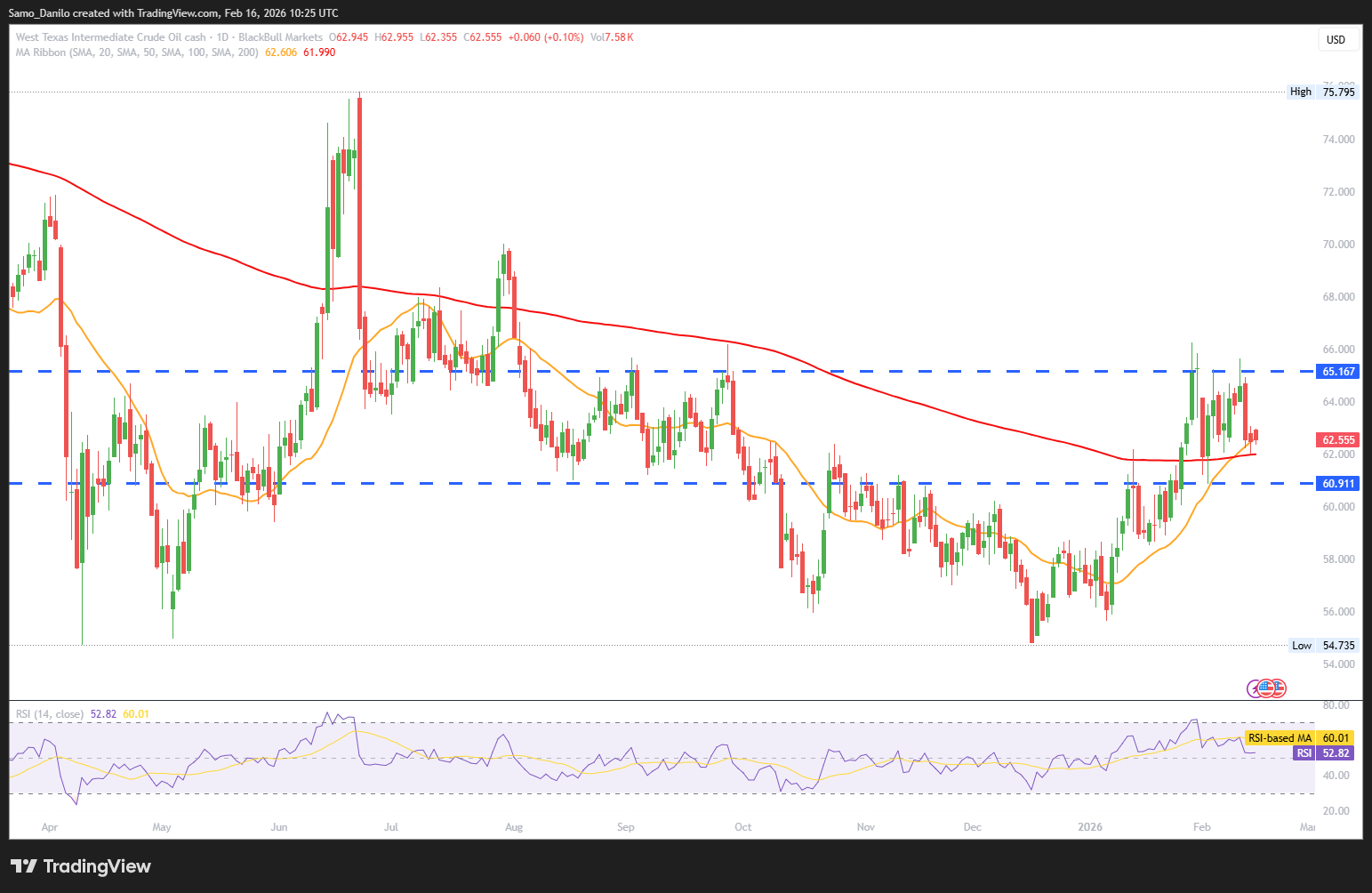
- Crude Oil Price: West Texas Intermediate (WTI) edges modestly lower after opening above its previous close, trading around $62.45 per barrel during Monday’s European session as traders turn cautious at the start of the week.
- Supply risks: Oil prices face renewed headwinds amid signs of ample global supply. According to OPEC+, the producer group is leaning toward resuming output increases from April, following a three-month pause, in anticipation of peak summer demand, a move that could weigh on prices if demand fails to keep pace.
- Pipeline tensions: Slovak Prime Minister Robert Fico accused Ukraine of delaying the restart of a pipeline transporting Russian oil to Eastern Europe, alleging the move is aimed at pressuring Hungary over its opposition to Ukraine’s prospective European Union membership. While largely political, such disputes keep regional energy flows in focus.
- New supply: Italian energy major Eni confirmed a significant offshore oil discovery in Angola’s Block 15/06, with preliminary estimates of roughly 500 million barrels of oil in place. The find highlights the effectiveness of infrastructure-led exploration and reinforces expectations of future supply growth.
- US-Iran diplomacy: Market attention now shifts to the second round of US-Iran talks, scheduled to take place in Geneva on Tuesday. Tehran has signaled a willingness to make nuclear concessions if Washington addresses sanctions, a development that could have significant implications for Iranian oil exports and global supply balances.
| SMA (20) | Rising | | |
| RSI (14) | Slightly Rising | |
|
| MACD (12, 26, 9) | Slightly Rising | |
Closing statement: WTI remains under pressure near the lower end of its recent range, with supply-side developments dominating sentiment. While geopolitical risks and diplomatic talks offer occasional upside catalysts, the prospect of rising OPEC+ output and new discoveries suggests rallies may struggle for follow-through unless demand data or geopolitical disruptions materially tighten the market.
DAX
- DAX Price: After a week of sideways trading, Germany’s benchmark index DAX starts the week with modest gains, currently hovering around 24,930 points as investors digest company news and macro data.
- Siemens Energy: Siemens Energy received a price target increase from 150 to 185 euros by RBC, which maintained its “Outperform” rating, providing confidence to equity investors.
- Volkswagen plan: According to Manager Magazin, Volkswagen plans to cut costs by 20% across all brands by 2028, with CEO Oliver Blume and CFO Arno Antlitz presenting the plan to top executives, aiming to improve margins amid weaker global demand.
- EU employment: While aggregate eurozone employment data is encouraging, differences persist: Spain saw employment rise 0.8% q/q, whereas Germany experienced a slight decline of 0.1% q/q, highlighting regional variations in labor market dynamics.
- Week ahead: Investors will monitor the ZEW Survey in Germany on Tuesday and the minutes of the FOMC’s January meeting on Wednesday for potential insights into monetary policy directions.
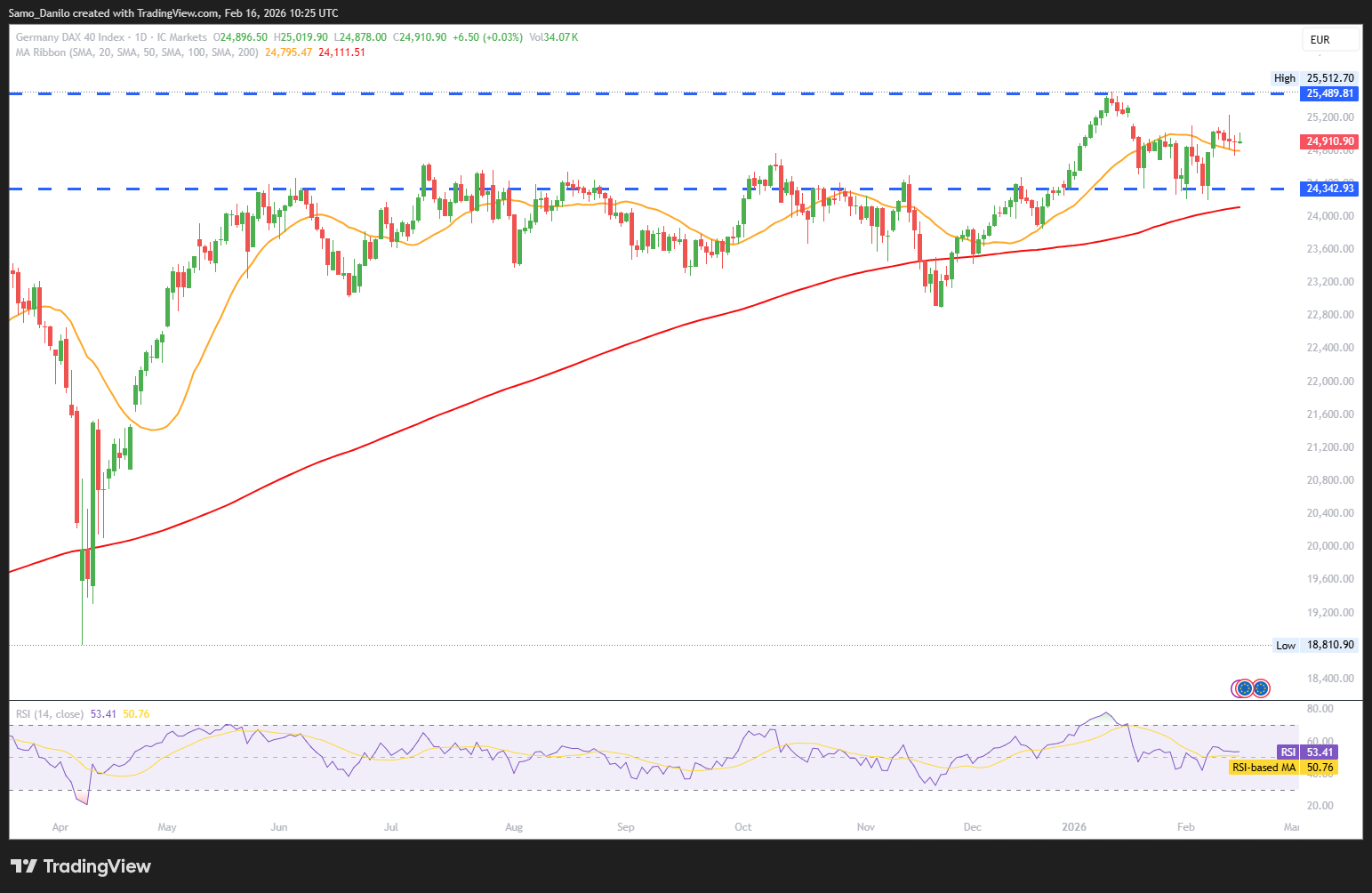
| SMA (20) | Slightly Rising | |
| RSI (14) | Slightly Rising | |
| MACD (12, 26, 9) | Slightly Rising | |
Closing statement: The DAX shows steady early-week gains but faces mixed signals from regional employment trends. Corporate news, particularly from Siemens Energy and Volkswagen, provides short-term support, while macro events like the ZEW Survey and FOMC minutes could drive volatility later in the week.