
EURUSD
- EUR/USD Price: EUR/USD started the new week with a bullish gap, benefiting from a weaker US Dollar as investors shifted away from safe-haven assets. Improved market sentiment and hopes for geopolitical de-escalation boosted demand for risk-sensitive currencies, including the euro.
- ECB's Lagarde: The European Central Bank (ECB) President Christine Lagarde stated during the Italian television program Che Tempo Che Fa that the European Central Bank is likely to revise its inflation forecasts higher at next month’s policy meeting. The comments reinforced expectations that the ECB could maintain a hawkish stance if inflation risks persist.
- US-Iran negotiations: Markets reacted positively to reports suggesting progress in negotiations between the United States and Iran. According to reports, a proposed memorandum of understanding could include a 60-day ceasefire, the reopening of the Strait of Hormuz, mine-clearing operations by Iran, and partial sanctions relief in exchange for de-escalation. The prospect of a diplomatic breakthrough reduced safe-haven demand for the US Dollar.
- Iran's position: Despite signs of progress, Iranian officials reiterated that managing the Strait of Hormuz remains Iran’s “legal right.” Significant disagreements also persist regarding Iran’s nuclear program and its relationship with Hezbollah in Lebanon, highlighting that major obstacles to a final agreement remain unresolved.
- EC position: EU Commission President Von der Leyen welcomed the reported progress toward an agreement between the United States and Iran. Her comments reflected broader European support for diplomatic efforts aimed at reducing geopolitical tensions and stabilizing global economic conditions.
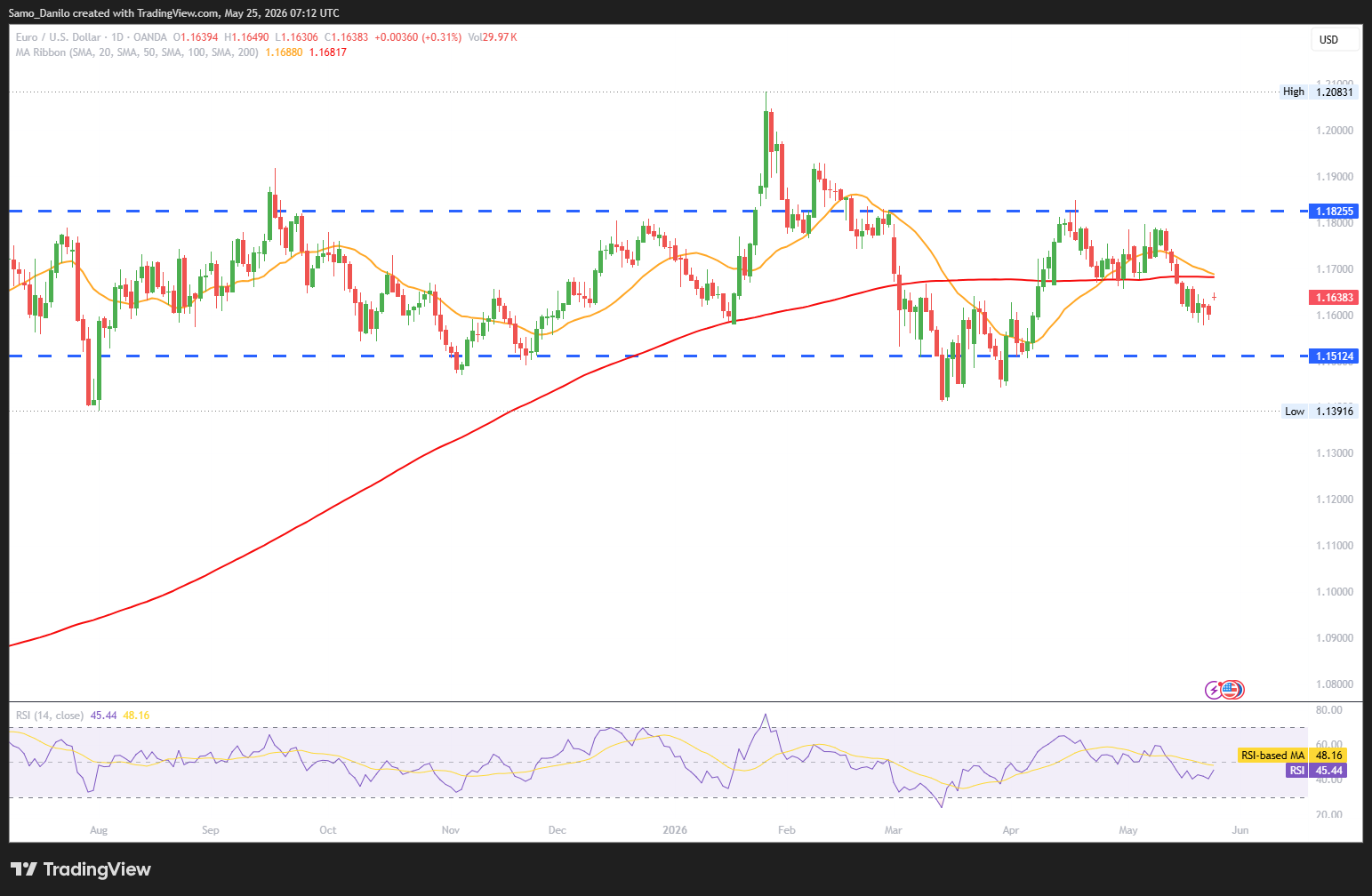
| SMA (20) | Slightly Rising |  |
| RSI (14) | Slightly Falling |  |
| MACD (12, 26, 9) | Slightly Falling | |
Closing statement: EUR/USD is benefiting from improved risk sentiment and expectations of higher ECB inflation forecasts. While growing optimism surrounding US-Iran negotiations has weakened the US Dollar, unresolved geopolitical issues mean market participants will remain attentive to further diplomatic developments and ECB policy signals.
GBPUSD
- GBP/USD Price: GBP/USD started the week on a stronger footing, advancing toward the 1.3500 level during Monday’s European session. Improved market sentiment and reduced safe-haven demand for the US Dollar helped support the British Pound.
- Peace deal: According to Axios, a senior US administration official stated that the White House does not expect a final agreement to end the Iran conflict immediately. Approval from Iran’s leadership, including Mojtaba Khamenei, could take several more days, suggesting that geopolitical uncertainty remains a key market risk.
- UK data: Recent UK economic releases have softened the outlook for further monetary tightening. Weaker retail sales figures and an unexpected rise in the unemployment rate to 5.0% prompted investors to scale back expectations for additional interest-rate increases from the Bank of England later this year.
- BoE's Taylor: BoE policymaker Alan Taylor suggested that an “extended hold” in interest rates may be sufficient under current conditions. He noted that second-round inflation effects appear less severe than those experienced during the Russia-Ukraine War due to a cooling domestic labor market.
- UK-EU trade: Reports indicate that the European Union rejected the UK’s proposal for easier access to the EU single market for goods ahead of a planned July summit. The setback highlights continuing post-Brexit trade challenges and could limit longer-term support for the British Pound.
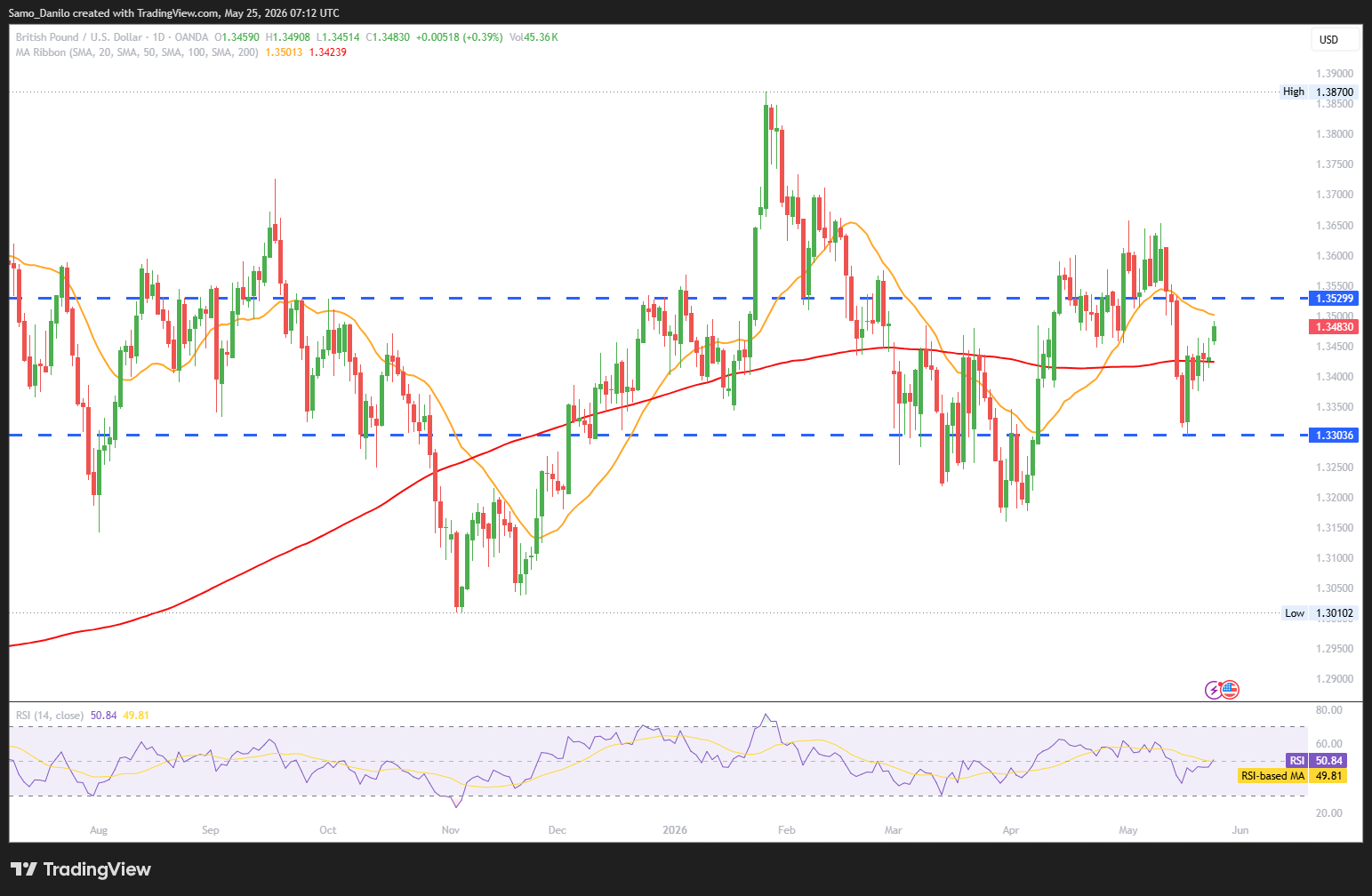
| SMA (20) | Slightly Rising | |
| RSI (14) | Slightly Rising | |
| MACD (12, 26, 9) | Slightly Falling | |
Closing statement: GBP/USD has benefited from improved risk sentiment and reduced US Dollar demand, but weaker UK economic data and fading expectations of additional Bank of England rate hikes may limit further upside. Investors will continue monitoring developments in US-Iran negotiations and UK-EU relations for fresh directional cues.
XAUUSD
- XAU/USD Price: Gold struggled to extend its modest gains toward the $4,580 region during Monday’s session and remained below the upper boundary of the range that has contained prices over the past week. Mixed fundamental drivers are preventing a decisive breakout in either direction.
- Fed chair: Kevin Warsh formally assumed leadership of the Federal Reserve before Friday’s US bond market close. Treasury yields edged slightly lower after Warsh reiterated that inflation could moderate over time and reaffirmed his commitment to institutional reforms at the central bank.
- Market odds: Investors are now fully pricing in a 25-basis-point interest-rate increase by January 2027. Sticky US inflation data and a series of hawkish comments from influential members of the Federal Open Market Committee have reinforced expectations that monetary policy may need to remain restrictive for longer, limiting gold’s upside potential.
- Geopolitical risks: Russia’s Belgorod Region reportedly came under missile attack, with damage reported to energy infrastructure. Continued geopolitical tensions and threats to critical energy assets provide an underlying source of safe-haven demand for gold.
- US Dollar: The US Dollar faced pressure after the University of Michigan revised its May consumer sentiment index lower to a record low. In addition, a strong rally in equity markets reduced demand for dollar liquidity, offering some support to gold despite expectations for tighter Federal Reserve policy.
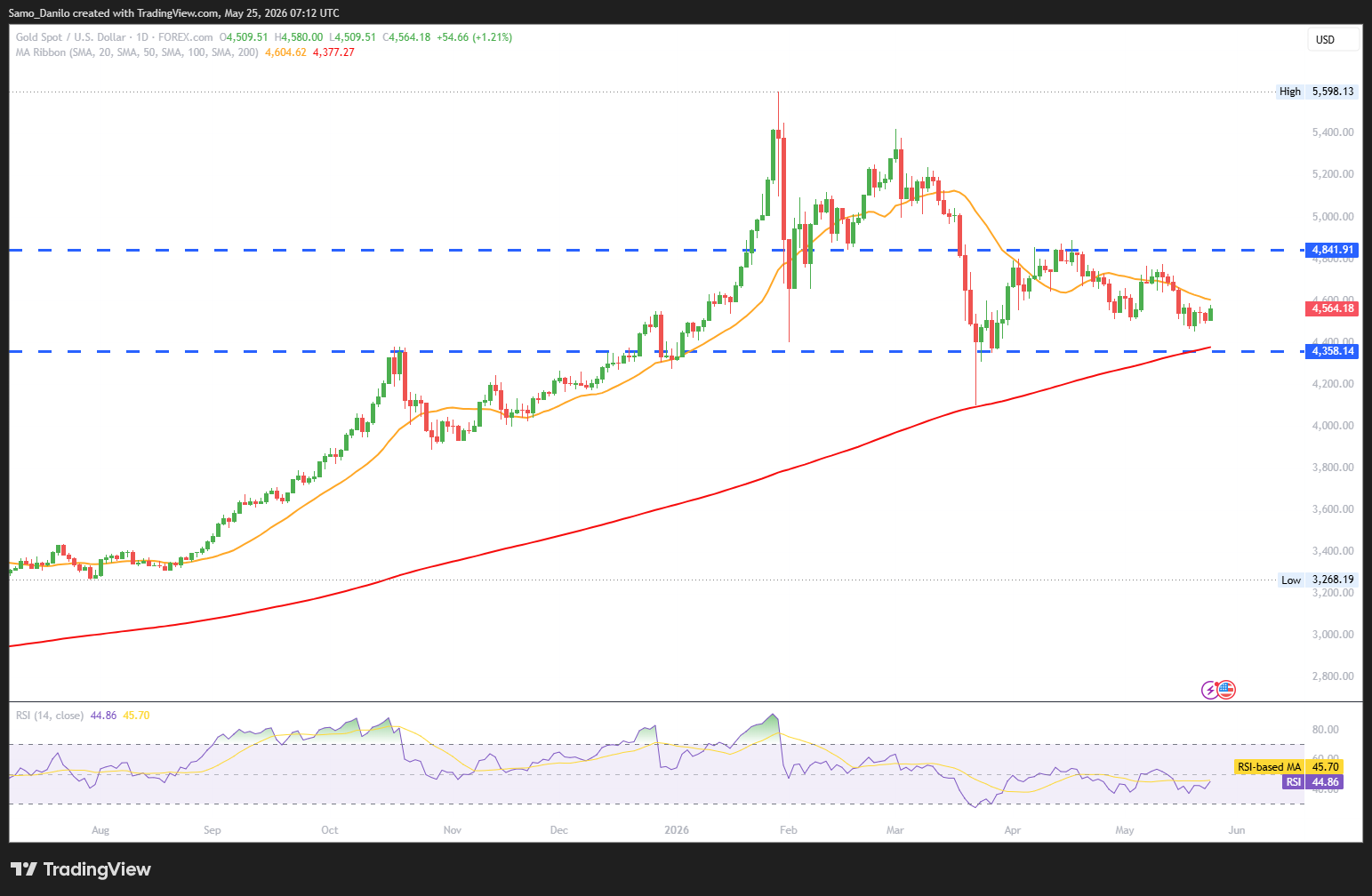
| SMA (20) | Slightly Falling | |
| RSI (14) | Slightly Falling | |
| MACD (12, 26, 9) | Slightly Falling | |
Closing statement: Gold remains caught between opposing forces: weaker US consumer sentiment, lower Treasury yields, and geopolitical risks are providing support, while expectations of future Federal Reserve rate hikes continue to cap gains. A clearer direction is likely to emerge from upcoming US inflation and monetary-policy signals.
CRUDE OIL
- Crude Oil Price: West Texas Intermediate extended its decline on Monday, falling more than 5% after opening with a bearish gap. The sharp move lower suggests traders are reassessing supply disruption risks and locking in profits after the strong rally driven by Middle East tensions.
- Shipping activity: According to Iranian state media, the Islamic Revolutionary Guard Corps Navy reported that 33 vessels passed through the Strait of Hormuz during the previous 24 hours after obtaining authorization from Iranian authorities. Continued traffic through the critical waterway has eased some fears of a complete disruption to global oil flows.
- EU outlook: Senior European Union officials stated that oil and natural gas prices are likely to remain elevated until at least the end of 2027. The lasting consequences of the Iran conflict are expected to maintain upward pressure on inflation while creating additional challenges for economic growth across Europe.
- Ukraine attacks: Ukrainian President Volodymyr Zelenskyy announced that Ukrainian forces targeted the Yaroslavl oil refinery in Russia during overnight operations. The continued attacks on Russian refining and export infrastructure highlight ongoing risks to global energy supply chains despite the market’s current focus on the Middle East.
- Pakistan oil: Pakistan is encouraging Persian Gulf oil producers to establish crude storage facilities within a planned Energy City project near one of its ports. The initiative aims to strengthen energy security by ensuring emergency access to strategic oil reserves during future geopolitical disruptions or supply crises.
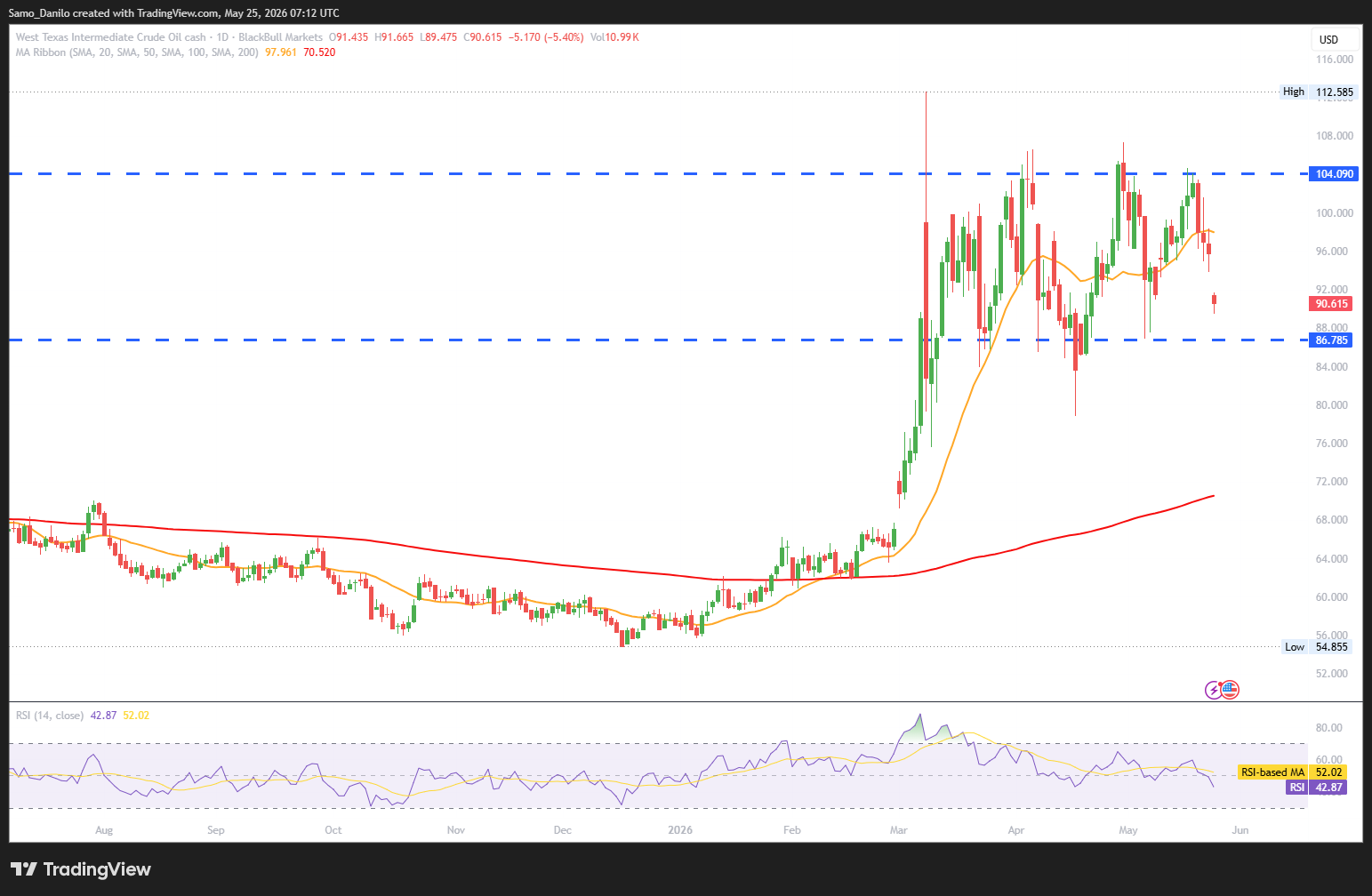
| SMA (20) | Slightly Rising | |
| RSI (14) | Slightly Falling | |
| MACD (12, 26, 9) | Slightly Rising | |
Closing statement: WTI crude oil is undergoing a significant correction as fears of immediate supply disruptions ease and shipping activity through the Strait of Hormuz continues. Nevertheless, geopolitical risks remain elevated, with tensions involving Iran, Russia, and Ukraine continuing to create uncertainty for global energy markets and long-term price stability.
DAX
- DAX 40 Price: DAX traded higher around 25,185 points during Monday’s European session. Investor sentiment remained relatively resilient despite persistent concerns surrounding energy prices, inflation, and geopolitical instability linked to the Middle East conflict.
- Inflation expectations: EU Economy Commissioner Valdis Dombrovskis tated after a Eurozone finance ministers’ meeting in Cyprus that higher energy costs are now expected to push inflation to 3.1% this year and 2.4% in 2027. These revised projections are significantly above previous forecasts and strengthen expectations that the European Central Bank may need to maintain tighter monetary policy for longer.
- Delivery Hero: Delivery Hero remained a major focus after reports that Uber is considering a full takeover bid valued at approximately 33 euros per share. The potential acquisition has fueled strong buying interest and renewed optimism surrounding consolidation within the food delivery sector.
- Jet fuel: Ongoing fears of jet fuel shortages linked to the Iran conflict are creating uncertainty in Germany’s travel market. A survey commissioned by SAP Concur showed that nearly one in five respondents had canceled, rebooked, or experienced disruptions to flights because of concerns surrounding fuel availability and aviation market instability.
- Auto sector: Mercedes-Benz announced plans to introduce its urban point-to-point autonomous driving system in Germany later this year after earlier deployments in China and the United States. The move highlights the company’s continued focus on advanced mobility technologies and reinforces Germany’s position in the global autonomous vehicle race.
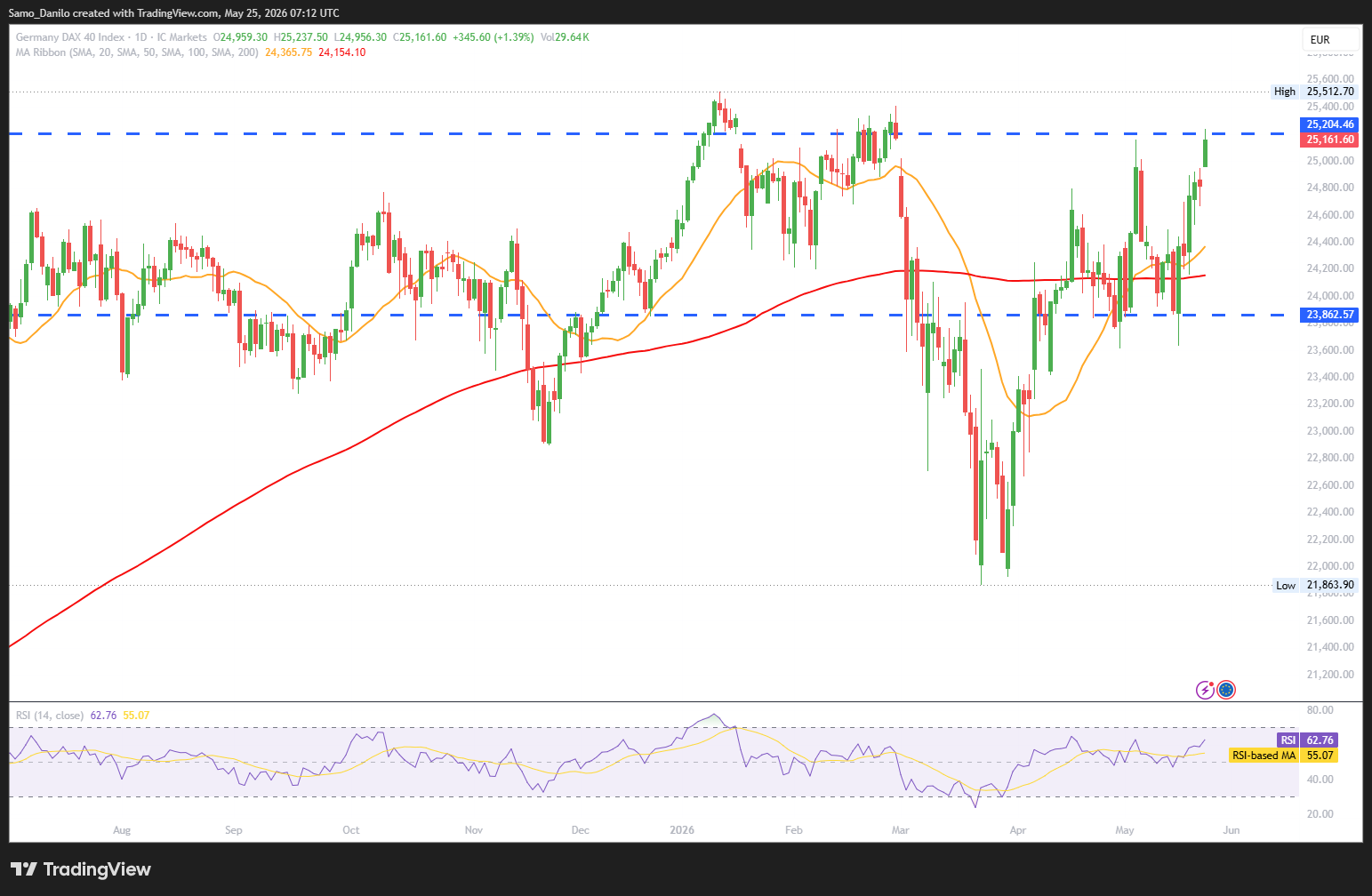
| SMA (20) | Rising | | |
| RSI (14) | Rising | | |
| MACD (12, 26, 9) | Rising | | |
Closing statement: The DAX 40 remains supported by corporate developments and strong investor appetite for technology and takeover-related stories. However, rising energy-driven inflation expectations and ongoing geopolitical risks tied to the Middle East continue to pose challenges for European growth and monetary policy outlooks.