
EURUSD
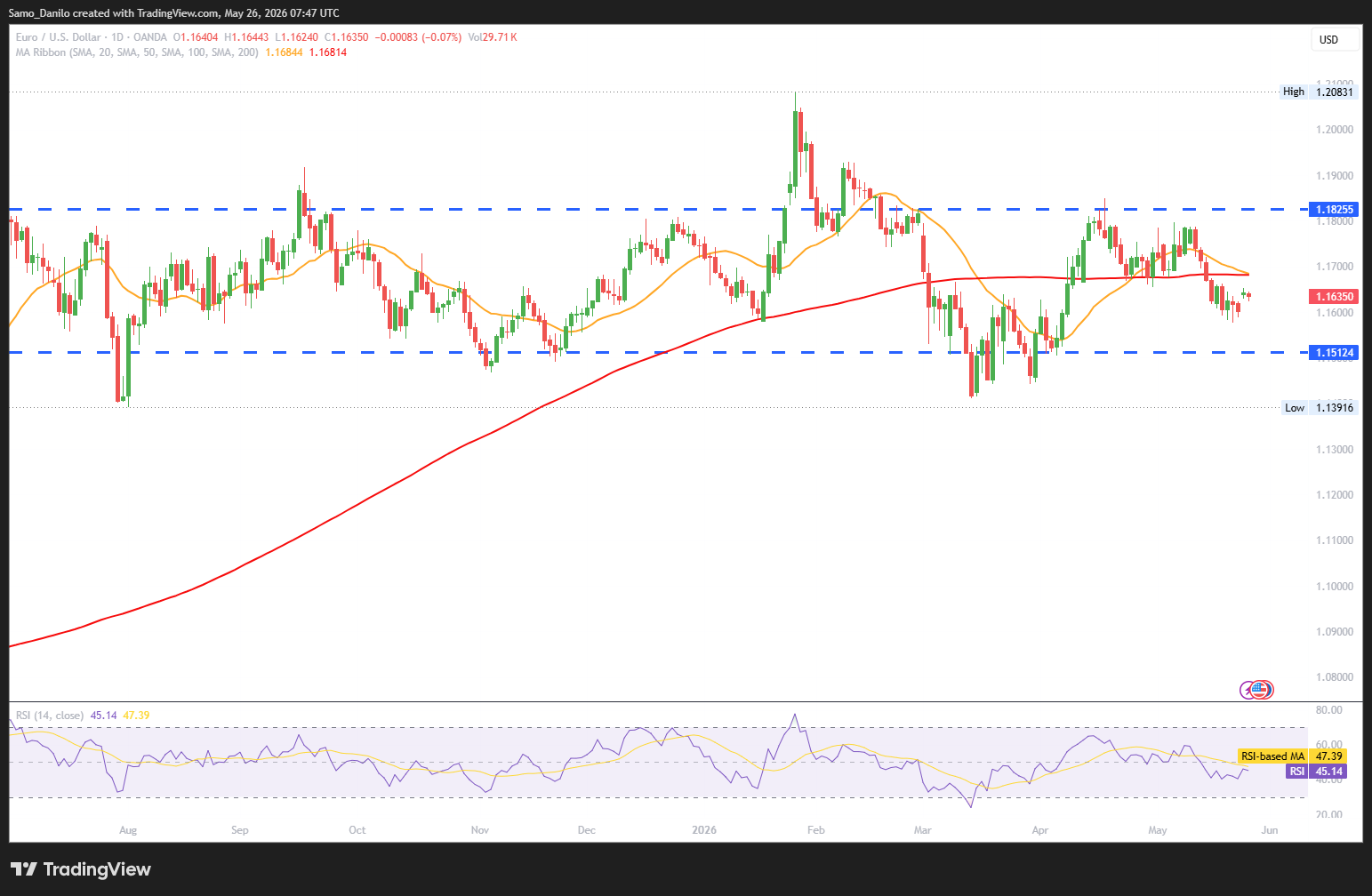
- EUR/USD Price: EUR/USD traded slightly lower around 1.1633 during Tuesday’s European session. The pair remains under pressure as investors balance expectations of tighter ECB policy against the continued strength of the US Dollar and uncertainty surrounding the global economic outlook.
- Wage growth: The European Central Bank’s negotiated wage indicator showed annual wage growth slowing to 2.5% in the first quarter of 2026 from 2.9% in the previous quarter. The softer wage data suggests underlying domestic inflation pressures may be easing somewhat, although the pace remains elevated relative to the ECB’s inflation target.
- ECB's Kocher: ECB policymaker Martin Kocher stated that the ECB is increasingly leaning toward raising interest rates next month, citing inflationary risks stemming from the Iran conflict and higher energy costs.
- ECB's Schnabel: ECB Executive Board Member Isabel Schnabel argued that monetary policy action may be necessary even if the Iran conflict were to end immediately. According to Schnabel, damage to global energy infrastructure could continue to fuel inflationary pressures and weigh on economic stability for an extended period.
- ECB tightening: Financial markets are currently assigning nearly an 85% probability to a 25-basis-point interest rate increase at the ECB’s June meeting. The shift in expectations reflects concerns that higher energy prices and geopolitical tensions could delay the return of inflation to the central bank’s target range.
| SMA (20) | Slightly Rising |  |
| RSI (14) | Slightly Falling |  |
| MACD (12, 26, 9) | Slightly Falling | |
Closing statement: EUR/USD remains constrained as traders weigh a more hawkish ECB against resilient US Dollar demand. While moderating wage growth provides some evidence of easing domestic inflation pressures, rising energy costs and increasingly hawkish ECB rhetoric continue to support expectations of further monetary tightening in the Eurozone.
GBPUSD
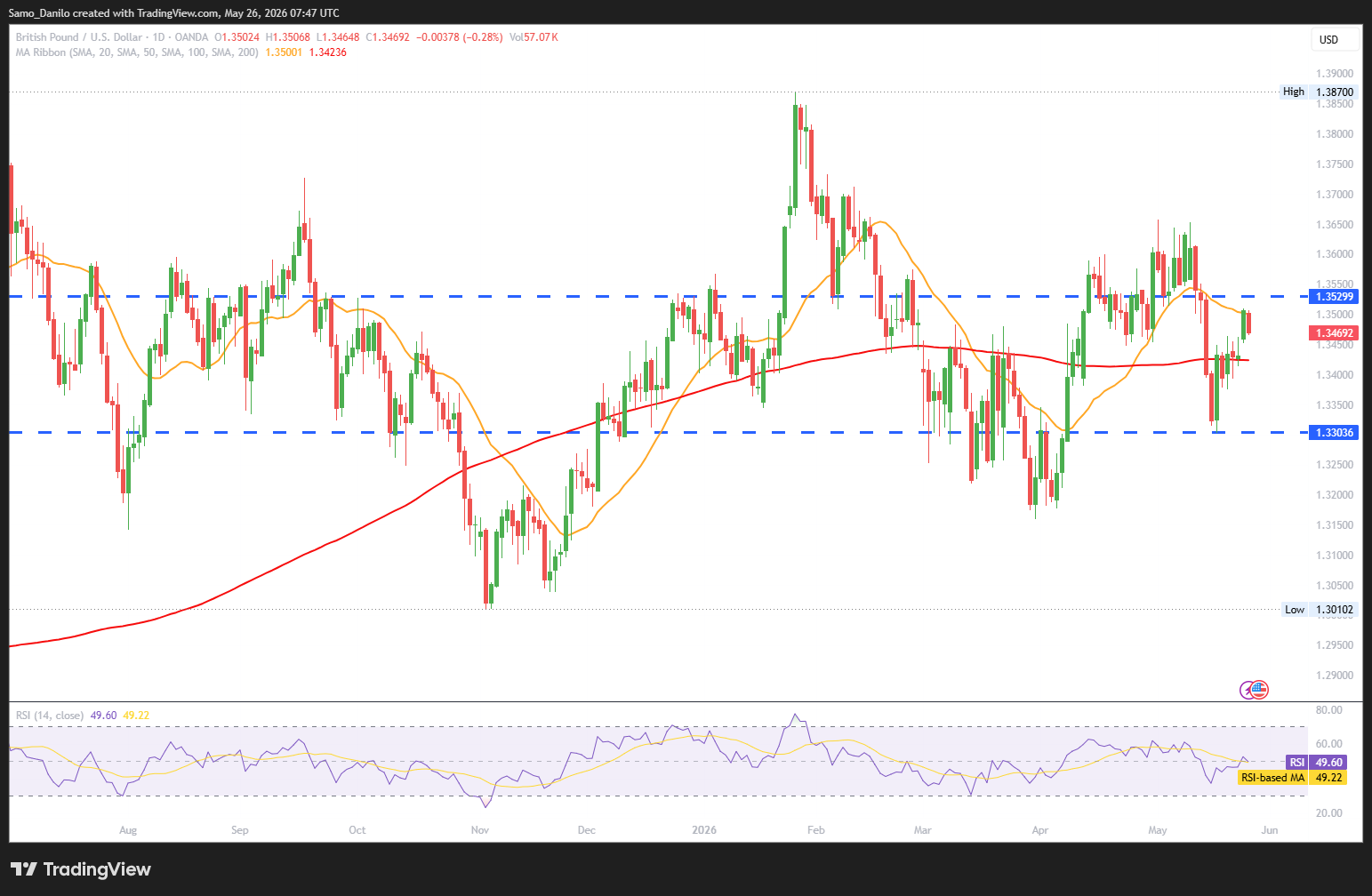
- GBP/USD Price: GBP/USD retreated during Tuesday’s European session after failing to build on Monday’s advance above the 1.3500 psychological level. The pair remains vulnerable to renewed US Dollar demand as investors continue to monitor geopolitical developments and monetary policy expectations.
- Middle East: The US military’s United States Central Command confirmed that American forces conducted strikes in southern Iran, describing the action as self-defense while maintaining support for the ongoing ceasefire.
- US Rubio: US Secretary of State Marco Rubio stated that the Strait of Hormuz must remain open and indicated that negotiations with Iran are still ongoing.
- The EU’s Commissioner for Startups, Ekaterina Zaharieva, suggested that the United Kingdom could potentially join the European Union’s €4 billion startup investment fund later this year. Although treaty changes would be required, closer UK-EU cooperation in innovation and technology investment could provide longer-term economic benefits and improve business sentiment.
- UK inflation: According to figures from the British Retail Consortium, UK consumers are likely to face higher prices for an extended period, with only a small share of businesses remaining unaffected by the Iran conflict. Persistent cost pressures across supply chains could keep inflation elevated and strengthen expectations that the Bank of England maintains a restrictive monetary policy stance.
| SMA (20) | Slightly Rising | |
| RSI (14) | Slightly Rising | |
| MACD (12, 26, 9) | Slightly Falling | |
Closing statement: GBP/USD has lost momentum after its recent recovery as geopolitical uncertainty and renewed US Dollar demand weigh on the pair. While potential UK-EU economic cooperation offers a constructive long-term narrative, persistent inflation pressures and Middle East-related risks are likely to remain the dominant drivers of Sterling performance in the near term.
XAUUSD
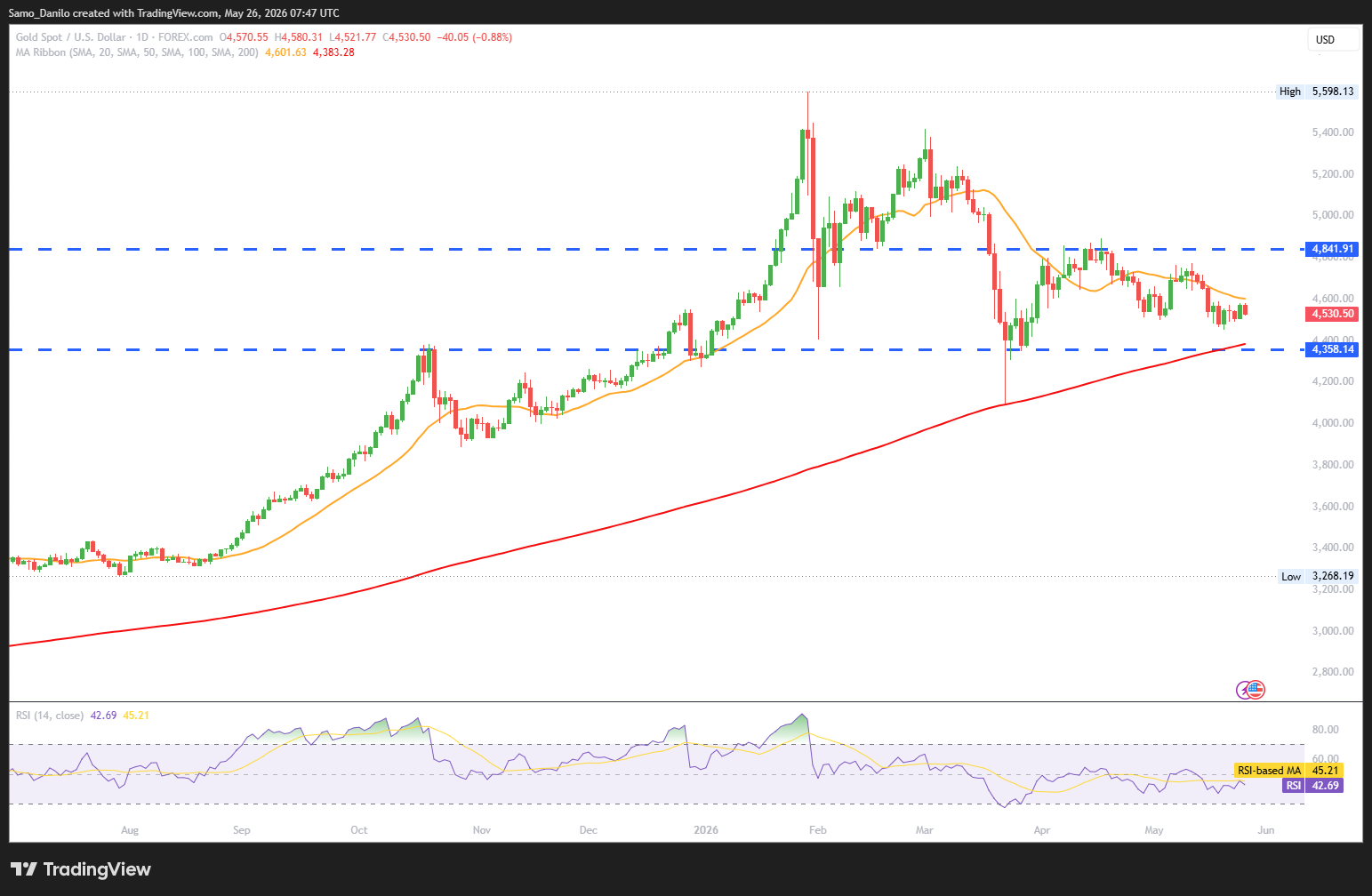
- XAU/USD Price: Gold came under renewed selling pressure during the European session, giving back a large portion of Monday’s rebound from recent lows. The failure to sustain momentum above the $4,580 resistance area suggests that traders remain cautious as higher interest-rate expectations strengthen the US Dollar and reduce the appeal of non-yielding assets.
- Fed's Waller: Fed Governor Waller indicated that the Federal Reserve should consider abandoning its previous easing bias and remain open to the possibility of future interest-rate increases.
- Fed's policy: Notably, Waller's views have often better reflected the consensus within the Fed than known hawks like Hammack and Logan, who have also advocated for removing the easing bias.
- Markets pricing: According to the CME FedWatch Tool, traders are now assigning meaningful odds to at least one Federal Reserve rate hike during 2026. Rising expectations for higher borrowing costs tend to support US Treasury yields and the US Dollar, both of which generally act as headwinds for gold prices.
- Key data: Investors are awaiting the upcoming US Personal Consumption Expenditures (PCE) Price Index and the revised US GDP figures due on Thursday.
| SMA (20) | Slightly Falling | |
| RSI (14) | Slightly Falling | |
| MACD (12, 26, 9) | Slightly Falling | |
Closing statement: Gold remains under pressure as increasingly hawkish Federal Reserve rhetoric boosts expectations for higher interest rates and strengthens the US Dollar. With markets closely monitoring upcoming US inflation and growth data, the near-term direction for XAU/USD will largely depend on whether economic releases support or challenge the case for further monetary tightening.
CRUDE OIL
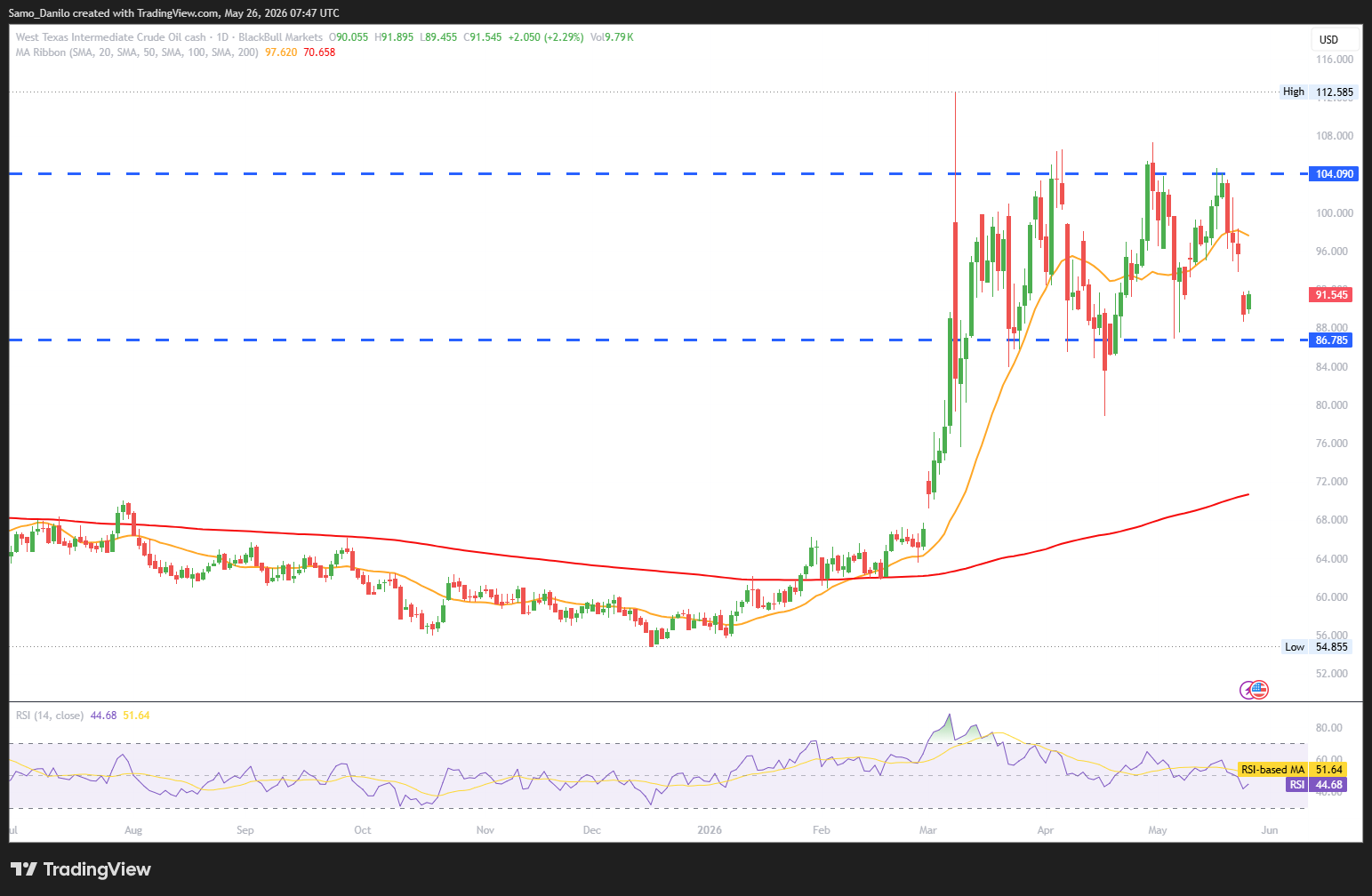
- Crude Oil Price: West Texas Intermediate recovered during Tuesday’s European session, trading around $91.85 per barrel after four days of losses.
- US-Iran agreement: US President Donald Trump stated that negotiations with Iran are progressing well and suggested that either a meaningful agreement will be reached or discussions will end altogether. Additional comments from senior Pakistani military officials indicating that a deal may be close have helped ease fears of prolonged disruptions in the region, putting downward pressure on the geopolitical risk premium embedded in oil prices.
- India demand: India has reduced its fuel demand growth forecast by nearly 40% as elevated crude prices, currency weakness, and fiscal tightening weigh on consumption. Slower growth in transportation and aviation fuel demand from one of the world’s largest energy consumers could limit the upside potential for global oil prices if these trends persist.
- Iraqi production: Iraq’s oil production has reportedly fallen sharply to approximately 1.39 million barrels per day as export disruptions linked to the Strait of Hormuz crisis continue to affect shipments. Authorities are accelerating efforts to restore alternative export routes through Turkey, including the Kirkuk-Ceyhan system and new pipeline infrastructure, though restoring lost volumes may take time.
- Pemex news: Petróleos Mexicanos avoided a credit-rating downgrade from Moody's Ratings despite Mexico’s sovereign credit rating being lowered to just above speculative grade. The decision provides some reassurance regarding the financial stability of one of the world's largest state-owned oil producers, helping reduce concerns about potential disruptions to future investment and production plans.
| SMA (20) | Slightly Rising | |
| RSI (14) | Slightly Falling | |
| MACD (12, 26, 9) | Slightly Falling | |
Closing statement: WTI crude oil is recovering as optimism surrounding a potential US-Iran agreement improves market sentiment and reduces immediate geopolitical fears. However, weaker demand expectations from India and severe production disruptions in Iraq highlight the continued balance between demand-side concerns and ongoing supply risks, which are likely to keep oil markets volatile in the near term.
DAX
- DAX 40 Price: DAX 40 is trading around 25,300 points on Tuesday morning, giving back some recent gains.
- Ifo survey: Germany’s latest Ifo Business Climate survey provided a modest positive surprise, indicating that business confidence improved slightly more than economists had expected following April’s sharp deterioration.
- ECB policy: ECB's François Villeroy de Galhau reiterated that the European Central Bank has not yet observed significant second-round inflation effects stemming from higher energy prices. His comments suggest that policymakers remain data-dependent and are still assessing whether recent inflationary pressures will become more deeply embedded in the broader economy before committing to further monetary tightening.
- Japan-Mercosur: Japan is reportedly pushing for a comprehensive economic partnership agreement with the Mercosur bloc in South America. Progress on such a deal could strengthen global trade flows and provide new opportunities for export-oriented economies, while also highlighting growing international competition for trade agreements at a time when geopolitical and supply-chain concerns remain elevated.
- Merck KGaA: Merck KGaA remains in focus as analysts offer conflicting assessments of the company's valuation. Analysts at Jefferies initiated coverage with a neutral “Hold” recommendation and a €129 price target, while analysts at JPMorgan continue to argue that the stock is undervalued, reflecting differing views on the company’s earnings outlook and growth prospects.
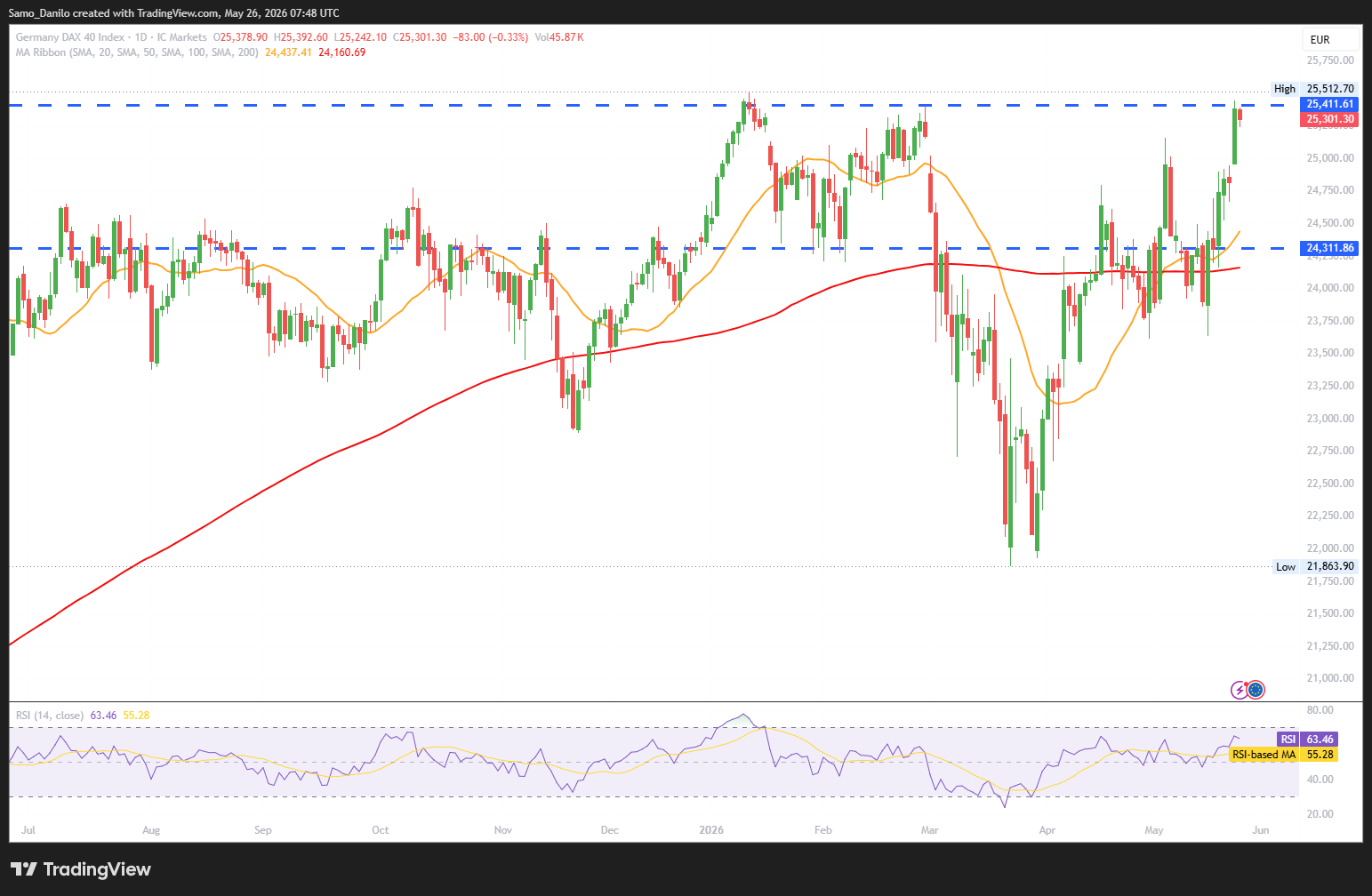
| SMA (20) | Rising | | |
| RSI (14) | Rising | | |
| MACD (12, 26, 9) | Rising | | |
Closing statement: The DAX 40 is trading modestly lower despite encouraging German business sentiment data. Investors remain cautious as they assess the ECB’s inflation outlook, evolving global trade initiatives, and mixed corporate signals.