
EURUSD
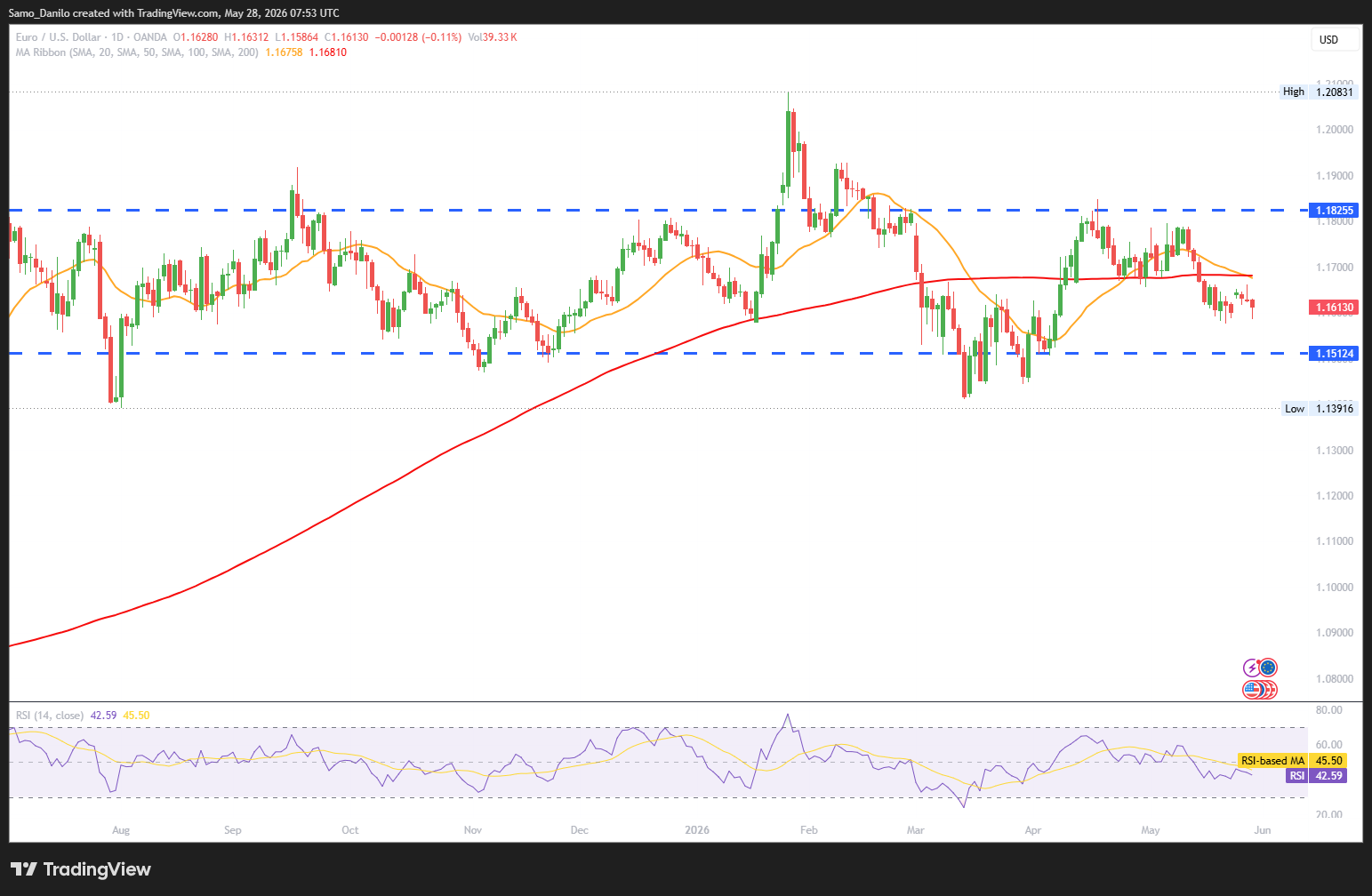
- EUR/USD Price: EUR/USD weakened toward the 1.1600 level during Thursday’s European session as investors moved back into the US Dollar.
- US strikes: The US military reportedly carried out additional strikes on Iranian military positions near Bandar Abbas, with United States Central Command stating that the targeted facilities posed threats around the Strait of Hormuz.
- ECB's Lane: The ECB Chief Economist, Philip Lane, cautioned that inflationary pressures resulting from the US-Iran conflict could continue even after hostilities eventually ease. Lane emphasized that the European Central Bank must prevent longer-term inflation expectations from becoming entrenched, reinforcing the increasingly hawkish tone emerging from several ECB policymakers in recent weeks.
- Meeting minutes: Investors are closely monitoring the release of the ECB’s March meeting minutes, which are expected to reveal growing support within the Governing Council for additional interest-rate hikes.
- ECB President: ECB President Christine Lagarde is scheduled to participate in a meeting of central bankers later on Thursday, and investors will closely analyze her remarks for signals regarding the future policy path. Any indication that the ECB is preparing for further tightening could help stabilize the euro, while a more cautious tone may reinforce current downward pressure on EUR/USD.
| SMA (20) | Slightly Falling |  |
| RSI (14) | Slightly Falling | |
| MACD (12, 26, 9) | Slightly Falling | |
Closing statement: EUR/USD remains under pressure as geopolitical tensions and expectations of further central bank tightening support the US Dollar. Hawkish ECB rhetoric continues to provide some support for the euro, but rising energy-related inflation risks and uncertainty surrounding the Middle East conflict are likely to keep volatility elevated in the near term.
GBPUSD
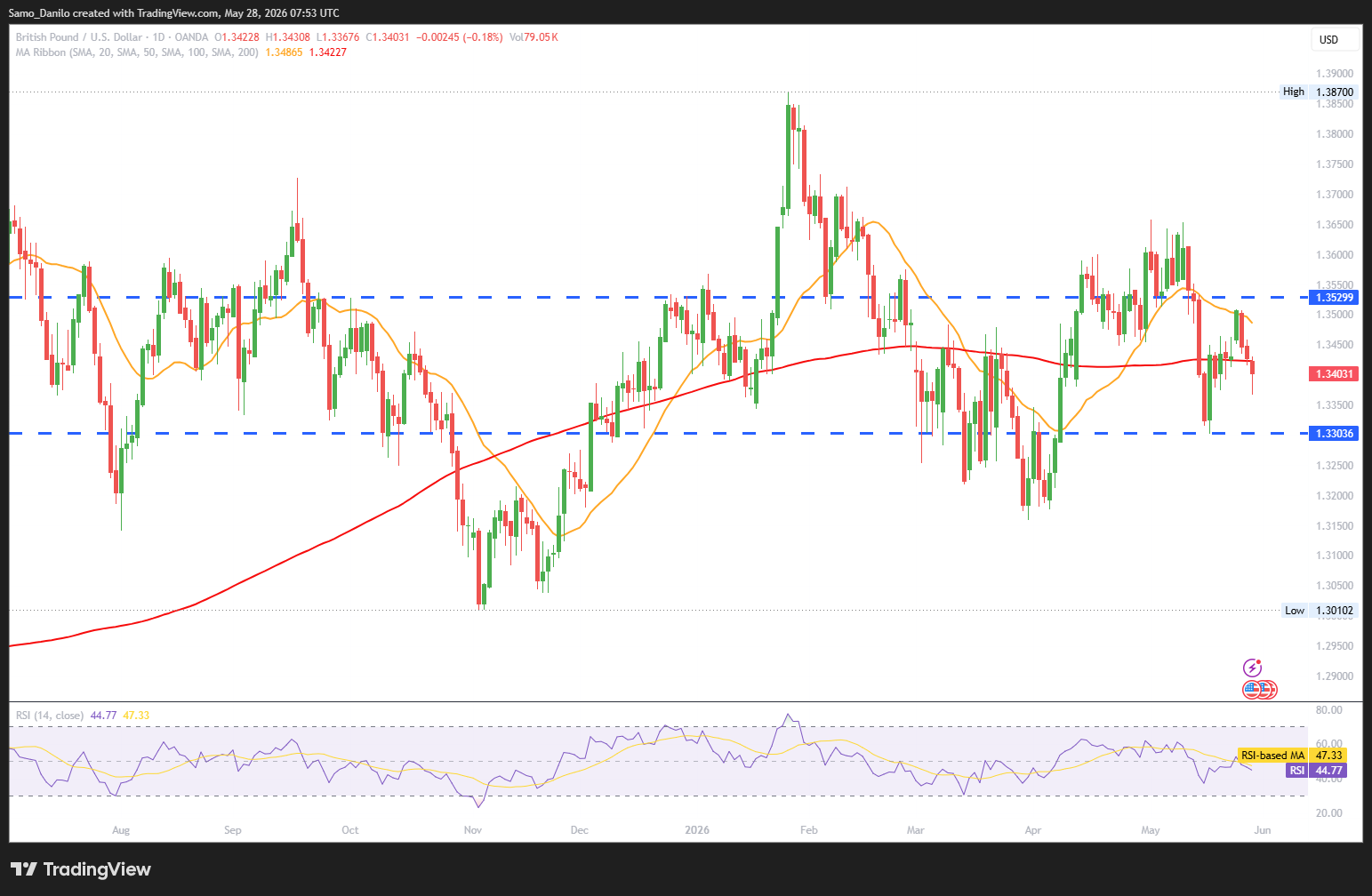
- GBP/USD Price: GBP/USD came under renewed selling pressure during Thursday’s European session, slipping toward the 1.3400 level.
- BoE policy: Investors have scaled back expectations for an imminent interest-rate hike from the Bank of England following softer UK inflation data and an unexpected rise in unemployment to 5.0% in April.
- UK Gilts: UK government bond yields rebounded strongly after an initially weaker market open driven by geopolitical tensions in the Middle East. The 10-year UK gilt yield recovered toward 4.87% from intraday lows near 4.81%, suggesting investors continue to reassess inflation risks and the possibility that elevated energy prices could keep borrowing costs higher for longer.
- Middle East: Islamic Revolutionary Guard Corps confirmed that Iranian forces targeted US bases in the Gulf region, while Kuwaiti authorities reported interceptions of hostile drone and missile attacks.
- Services sector: The latest survey from the Confederation of British Industry showed that sentiment among UK consumer-facing services businesses fell to its weakest level since February 2025. Companies reported declining profits, reduced investment activity, and slower hiring plans as surging energy prices fueled concerns over inflation and weakening consumer demand.
| SMA (20) | Slightly Falling | |
| RSI (14) | Slightly Falling | |
| MACD (12, 26, 9) | Slightly Falling | |
Closing statement: GBP/USD remains under pressure as softer UK economic conditions and reduced expectations for Bank of England tightening weigh on Sterling. At the same time, escalating geopolitical tensions in the Middle East continue to support the US Dollar through safe-haven flows, leaving the pair vulnerable to further downside unless UK economic sentiment improves materially.
XAUUSD
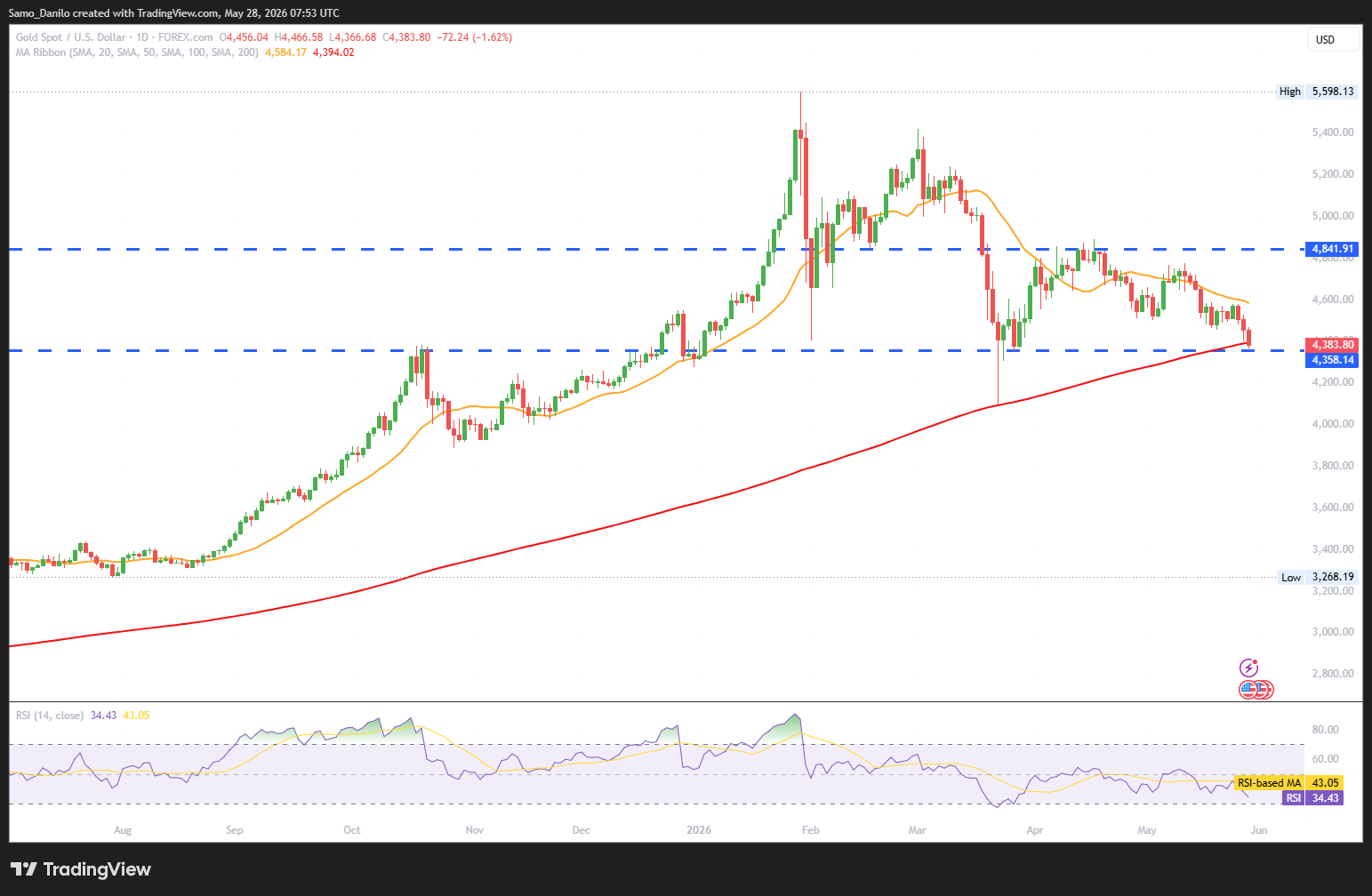
- XAU/USD Price: XAU/USD remains under heavy selling pressure during Thursday’s European session, trading just above the $4,390 level after touching its lowest point in nearly two months earlier in the day.
- Trump’s comments: US President Donald Trump stated that he is dissatisfied with the terms currently being negotiated with Iran and emphasized that the United States will not rush into a deal. His remarks weakened market expectations for a near-term diplomatic resolution to the prolonged Iran conflict.
- Market expectations: According to the CME Group FedWatch Tool, traders are pricing in nearly a 50% probability that the Federal Reserve will raise interest rates by 25 basis points before the end of this year. Markets are also assigning a significant chance of another increase in January 2027, reflecting growing concerns that inflation may remain elevated for an extended period.
- Treasury yields: US government bond yields moved higher again, with the benchmark 10-year Treasury yield climbing above 4.5% while the 30-year yield remained above the psychologically important 5% threshold. Higher bond yields increase the opportunity cost of holding gold, making interest-bearing assets more attractive and contributing to ongoing downward pressure on precious metal prices.
- PCE Inflation: Market participants are now focused on the release of the US Personal Consumption Expenditures (PCE) Price Index, the Federal Reserve’s preferred measure of inflation. March PCE inflation stood at 3.2% year-over-year, significantly above the Fed’s 2% target, and investors expect April data to confirm that price pressures remain persistent. A stronger-than-expected reading could further support the US Dollar and Treasury yields while weighing additionally on gold prices.
| SMA (20) | Slightly Falling | |
|
| RSI (14) | Falling | | |
| MACD (12, 26, 9) | Slightly Falling | |
Closing statement: Gold remains under significant pressure as rising Treasury yields and growing expectations for future Federal Reserve tightening continue to strengthen the US Dollar. While geopolitical tensions surrounding Iran persist, inflation concerns and monetary policy expectations are currently dominating market sentiment, leaving XAU/USD vulnerable to further downside if upcoming US inflation data remains elevated.
CRUDE OIL
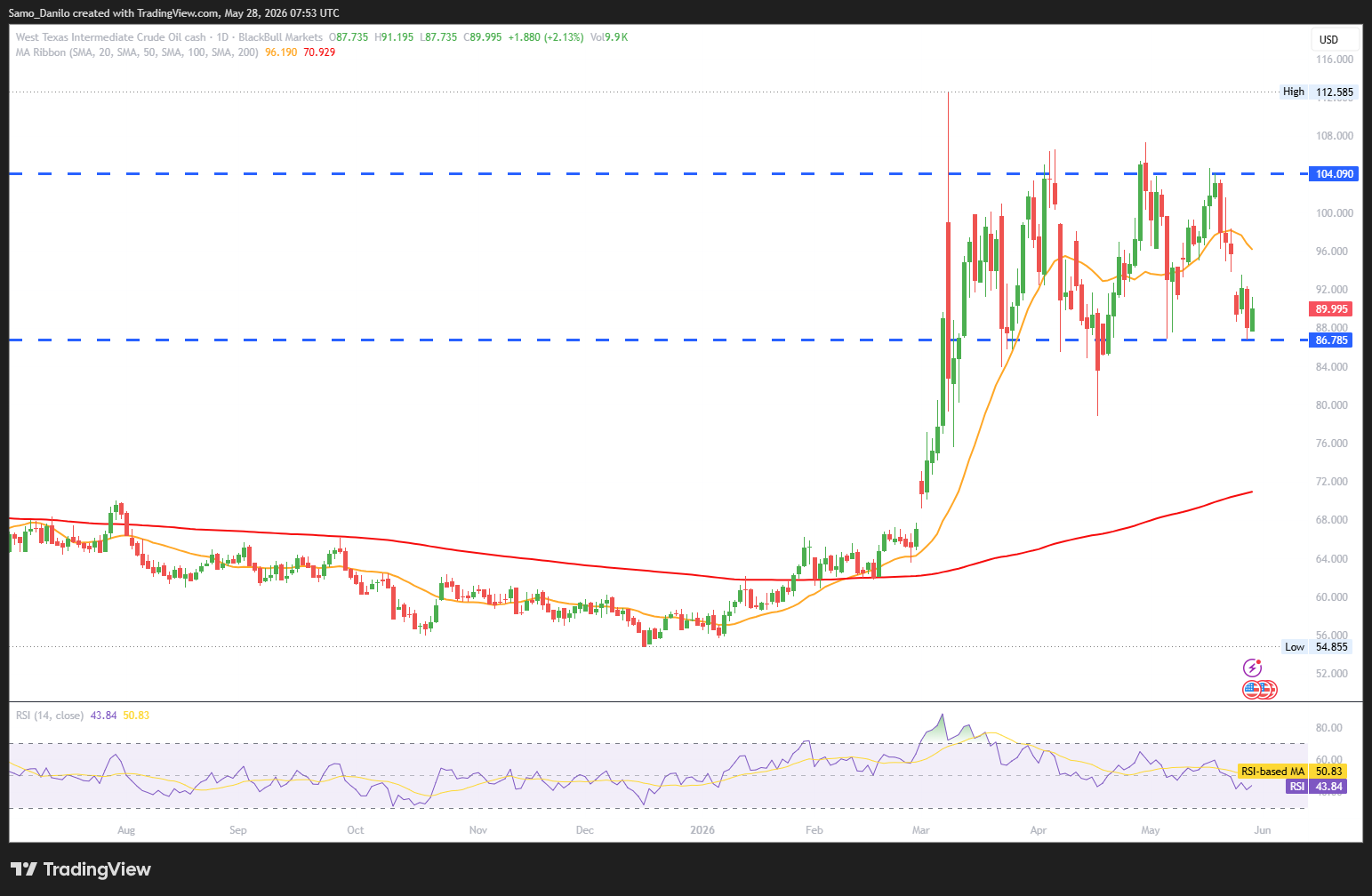
- Crude Oil Price: WTI Crude Oil continues to gain momentum during Thursday’s European session, testing the key $90 per barrel level.
- Norway oil: Investors are closely monitoring Norway’s upcoming Oil Investment Survey for indications of whether higher crude prices are encouraging energy companies to expand capital spending plans.
- Global inventories: Analysts warn that worldwide oil inventories are rapidly approaching minimum operational levels, particularly across Asia where shortages have become increasingly severe. Ongoing export disruptions linked to the Strait of Hormuz crisis, combined with strong seasonal fuel demand, are tightening the market far faster than many traders initially anticipated, continuing to provide strong support for crude prices.
- Russian fuel: A Russian tanker carrying approximately 270,000 barrels of diesel fuel reportedly failed to reach Cuba after weeks of attempting to navigate sanctions-related restrictions. The vessel ultimately turned toward Brazil, highlighting how US and EU sanctions continue to complicate global fuel logistics and contribute to inefficiencies in already stressed energy supply chains.
- API report: The American Petroleum Institute estimated that US crude oil inventories declined by 2.8 million barrels in the week ending May 22, following a significantly larger 9.1 million barrel draw the previous week. Although inventories remain higher overall this year, the recent consecutive declines reinforce concerns that supply conditions are tightening amid elevated global demand and geopolitical disruptions.
| SMA (20) | Slightly Falling | |
| RSI (14) | Slightly Falling | |
| MACD (12, 26, 9) | Slightly Falling | |
Closing statement: WTI crude oil remains firmly supported as tightening global inventories, geopolitical tensions, and supply disruptions continue to outweigh concerns about slower economic growth. Markets will closely monitor future inventory data, investment trends, and developments around global shipping routes, particularly the Strait of Hormuz, for direction on the next major move in oil prices.
DAX
- DAX 40 Price: DAX 40 is trading around 25,120 points during Thursday’s European session, with investors adopting a cautious tone amid mixed corporate developments and broader global uncertainty.
- Siemens outlook: JPMorgan Chase reiterated its “Overweight” rating on Siemens with a €335 price target. Analyst Phil Buller highlighted strong optimism among Asian investors regarding the long-term growth potential of artificial intelligence and data-center infrastructure themes, which continue to support confidence in Siemens’ industrial automation and digitalization businesses.
- Bayer news: Bayer remains under pressure after US seed company Latham Quality filed a lawsuit accusing Bayer of monopolizing the American market for genetically engineered corn seeds. The case adds to Bayer’s ongoing legal challenges and may increase investor concerns regarding regulatory risks and future litigation-related costs.
- Rheinmetall news: Rheinmetall announced that it will supply more than 2,000 military trucks to the German armed forces under a contract worth slightly over €1 billion. The order is expected to be included in Rheinmetall’s second-quarter results and reinforces the strong demand environment for European defense companies amid rising regional security spending.
- Fresenius news: Fresenius Medical Care confirmed plans to begin a new share buyback program starting May 28, 2026, with completion targeted within the following 12 months. Share repurchase programs are generally viewed positively by investors as they can improve shareholder returns and signal management confidence in the company’s long-term financial outlook.
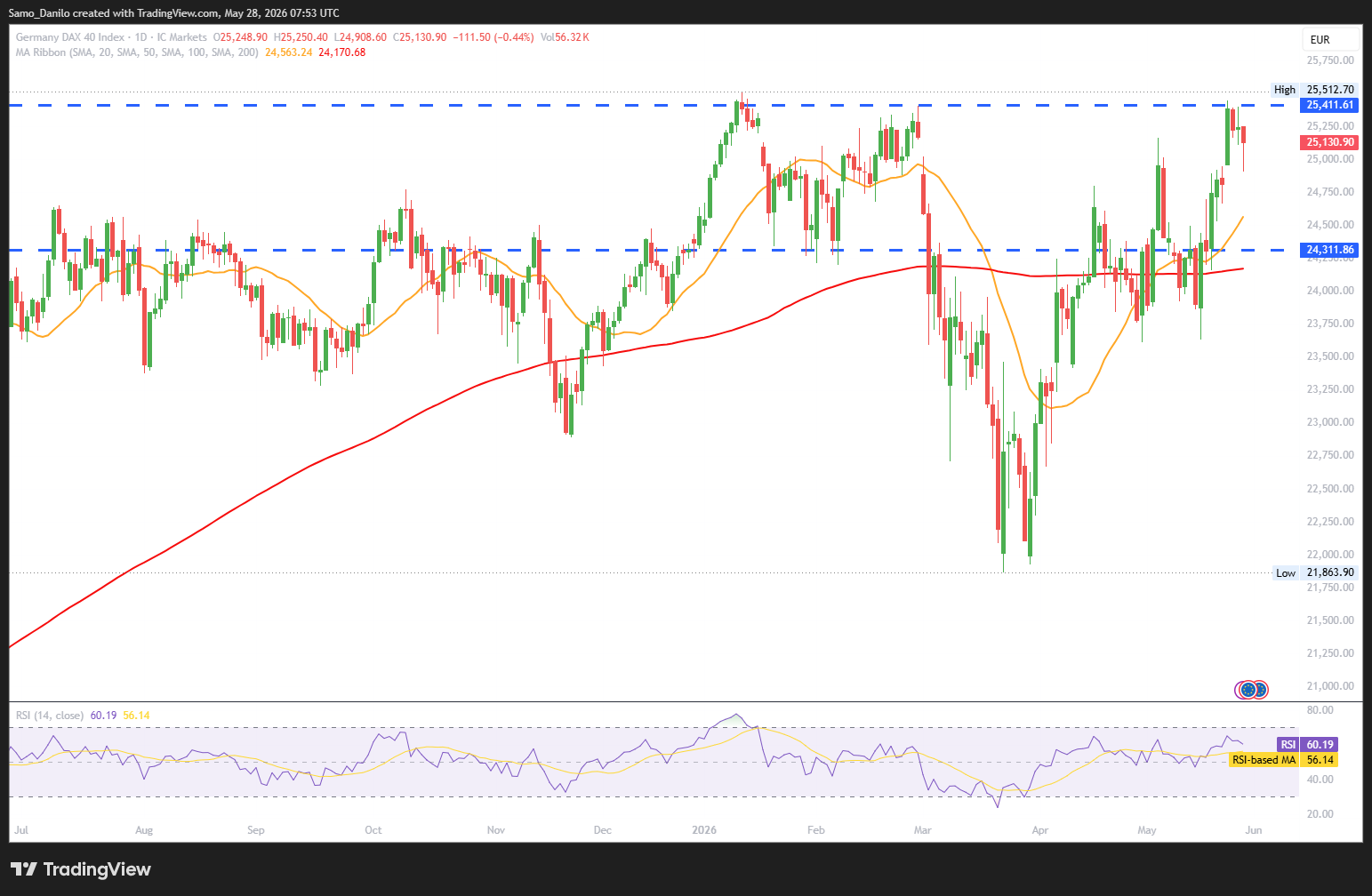
| SMA (20) | Rising |  | |
| RSI (14) | Rising | | |
| MACD (12, 26, 9) | Rising | | |
Closing statement: The DAX 40 remains under mild pressure despite strong corporate news flow from major German companies. Investor optimism surrounding AI-related growth, rising defense spending, and shareholder return initiatives continues to support selected sectors, while legal risks, geopolitical uncertainty, and broader macroeconomic concerns remain important factors influencing overall market sentiment.